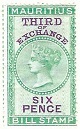
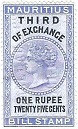
Handstamps from the Start of Occupation by the British from 1810 (King George III Use)
Obviously, something was needed to replace the French revenue stamps
after the British occupation, if it were possible to continue to collect
revenue in the same manner as earlier. Very little in the way of
archives has been discovered, although there is a brief reference to
some handstamps which were used during the reign of King George III
contained within William A Barber’s book “The Impressed Duty Stamps of
the British Colonial Empire”.
Plate 4 contains colour copies of four examples – the only ones that
I have seen and which have all come to light in the past three or so
years but not, I must stress, due to any specific research on these by
me. This is because I have been unable to trace any research material of
any substance.. The red squares are inscribed "Internal Revenue" and the
black circular stamps display the duty paid.
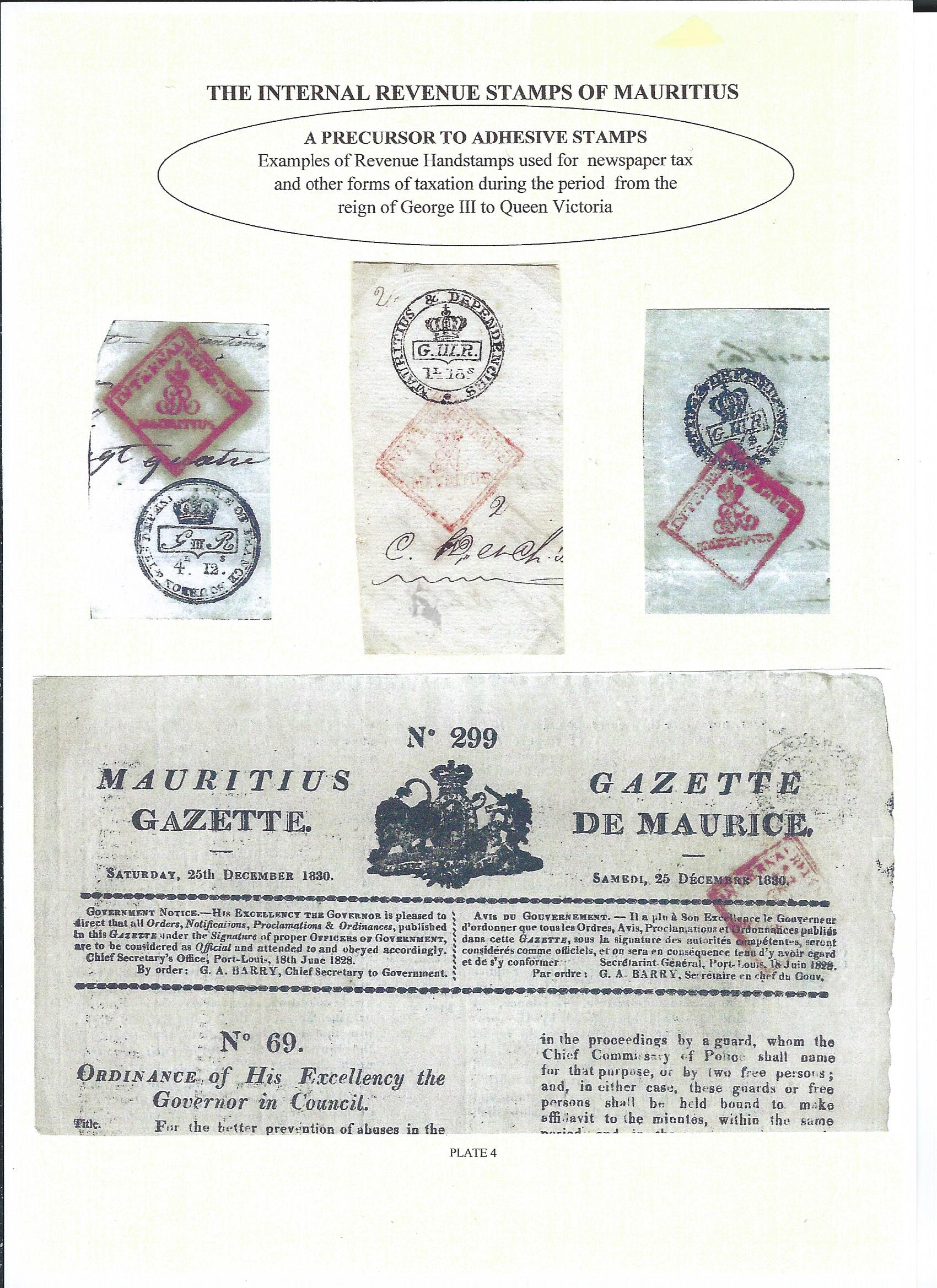
The first and second of these exhibits show much clearer pictures of
the black circular duty stamp. On the third example, the duty amount is
obliterated by the red stamp. No dates are shown at
all on the impressions. Although the circular stamps are all shown as "G
III R", the crowns are all different, but one can reasonably assume that
they were all used between 1810 when the British first occupied the
island and 1820, when King George III died. Maybe one can extend this
end date a little further, before the authorities got around to
producing new dies.
On the large cutting from "The Mauritius Gazette",
the impressions are not at all clear, but the newspaper is dated
somewhat surprisingly on Christmas Day 1830. It is impossible to tell
which Monarch is shown on the black impression. In
the absence of any supporting data, one must expect the reigning King in
1830 which could have been George IV or William VI as the former died
during that year. Again, the George IV die could still have been used
after William VI had succeeded.
Continuing on the question of "overlaps", the rim
of the black impression on the first item on the
plate reads "Isle of France" etc so, although this
was a George III stamp, the original French name of
the island was still being used.
I had hoped that I might have found some reference to the George III
period in Peter Ibbotson’s two excellent books on Mauritius Postal
History and Stamps, but nothing appears. This could be because, at the
time these were written, none of the above examples had actually come to
light.
The large cutting is the only evidence I have of how these
impressions were used i.e. for the collection of newspaper tax. We take
it fro granted today that dissemination of news is accessible cheaply to
everyone, but this was not always so. These
levies must have been used on other documents, as can be seen if one
looks again at the first three examples on Plate 4 and the scraps of
manuscript.