Introduction
For the uninitiated, there can probably be little more boring than attempting to read a book based on a remote aspect of the hobby of philately. Indeed, this treatise is unlikely to attract anyone but the dedicated collector of Mauritius philately in all its forms; or perhaps a person wishing to find an unusual and fascinating offshoot upon which to concentrate.
To budget for a large print copy would therefore be
most unwise, not only because of the lack of potential reader numbers,
but also because this is the first edition. Therefore, there is a
likelihood that I shall be trampled underfoot by the erudite in our
fraternity urging me to make many corrections and include aspects which
ought to be in the book. In fact, I hope that I am, because I am very
conscious of the shortage of data in some areas, and there is nothing I
would like better than to be able to improve some of the
information-impoverished areas. Some of these may well be due to me not
having examined parts of the more detailed areas of research, occasioned
by both time and cost.
To travel to Mauritius is a long journey and,
although research has been for my own collection as well as for the
book, there comes a limit to the cost/benefit analysis!
In making the remarks in the foregoing two
paragraphs, I have in mind the experience of the well-known doyen of
Mauritian philately, Peter Ibbotson who, sadly, is no longer with us.
Whilst I have not the slightest wish to compare my humble efforts to the
writings of Peter’s stretching over many years-and to which I am a
disciple, he wrote a very good volume in 1991 (published by the Royal
Philatelic Society London) entitled “Mauritius Postal History and
Stamps”. Four years later, there was a further book (this time published
by the Indian Ocean Study Circle) which he called Mauritius Postal
History and Stamps Revisions and Additions”.
I am very grateful for
the support I have received from so many people. I hope that I have
succeeded in listing them all in my acknowledgements on a separate page.
I pray that I have not offended anyone, but no doubt they will let me
know……! I am disappointed from the lack of data I have received from the
various Mauritian authorities with whom I have been in touch. In several
cases, despite being reminded, I have not even received the courtesy of
any reply – even to say that they cannot help. I think I could have
improved this by being able to visit the island more often.
I have been truly amazed at how much material for
research is now available on the web. That, and the advent of email, has
made my task easier. I do not envy researchers on these type of subjects
who had to manage without such benefits not so many years ago.
How do I come to find myself in this position of
book-writing, you may ask? Well, I will make the history as short as
possible, although no doubt many of you have experienced the same
transitions if you have been involved in philately for most of your
life. I started as a seven year old, when quantity was king. As
schoolboys, we always counted the number of stamps we had, and whether
it was more than our friends. Did someone mention quality? That didn’t
matter. In fact, I did not trust stamp hinges and stuck all mine in the
album with glue made by my mother from flour and water. They certainly
stayed put! It was an
all-world collection, and so it remained for quite a few years, being
relegated to a storage cupboard from teenager through marriage and
fatherhood. During my forties , the collection was revived and I
discovered that there had been a revolution in philately in those
intervening years. Suffice to say that I gradually became more and more
specialised over the years, as I began to realise that one could not
possibly collect all the stamps in the world. Thus, I became fascinated
with the background to the island of Mauritius and its interesting stamp
history Nestling in my mind was the remote possibility that I might
luckily discover one of the “Post Office” issues, and make my fortune.
No such luck.
But Mauritius offered many other attractions, so I
stuck with it, and discovered many branch lines down which to travel,
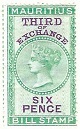
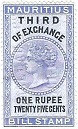
apart from merely collecting postage stamps from SG 3 onwards. One of
these branch lines was the Revenue stamps, where I was very fortunate to
become really interested at a time when there were two or three dealers
who were able to offer me some interesting material, some of which was
derived from the De La Rue archives.
I was then foolish enough to give a show to the
Indian Ocean Study Circle; it was there that someone (who shall be
nameless!) suggested I might think about writing this book. I have
always been a soft touch for taking on too much, my long-suffering wife
tells me, so here I am.
John Wilson
February 2014