Stamps Printed by Thomas de la Rue Ltd in Great Britain
from 1869 Onwards
Bills
of Exchange Stamps
Why both the locally-designed and printed stamps were issued in
1869 is a matter of conjecture as, to my knowledge, no official
explanation is available. As previously mentioned, it could be that
there were only limited numbers available locally. It is possible, of
course, that there could have been some controversy surrounding the
local issues, as they were hardly comparable with what was produced by
order of the Crown Agents, but I simply do not know whether any truth
exists in this surmise. There could be a very straightforward
explanation!
My personal view is that, because the
stamps did not contain a portrait of the Monarch's head, they
contravened regulations.
The De La Rue printings were for the same values as the local stamps,
and therefore the scale of duty remained the same. All Bill of Exchange
stamps were printed in sheets of ninety comprising thirty strips of
three (first, second and third of exchange) with the single exception of
the 1876 1d value which was printed in sheets of 120.
Plates 11 and
12 display in triptych imperforate proofs
form, mounted on card of the nine values issued in 1869. Both the
Barefoot and Forbin catalogues state that all eleven values were issued
at the same time, but it would appear that the 3s4d and the 16s8d stamps
were not issued until January 1872. The charge for the “overprint
formes” (a phrase used by the printers to describe the plate used to
print the value on the stamp) was shown on the De La Rue invoice in
1872, it is reasonable conclusive evidence that they did not exist at
the time of the 1869 printings.
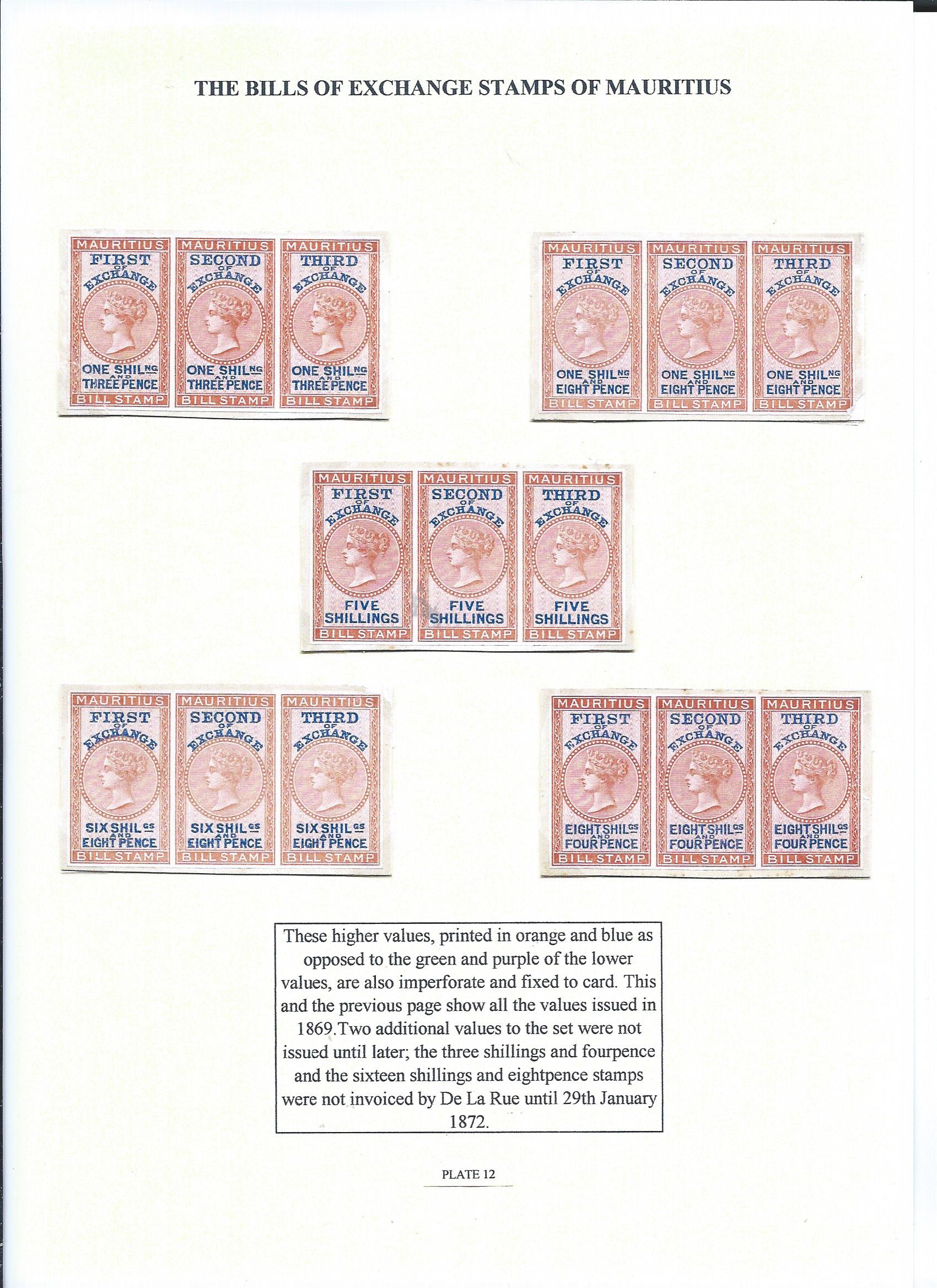
Plate 12 (click to enlarge)
Plates 13 and
14 contain a further set of the 1869
issues, again as imperforate proofs, but not on card this time. They are
also overprinted “CANCELLED” (type D7 from the Samuel catalogue).
We then come to Plates
15 and
16, which show the 1869
and 1872 stamps in their final issued state in mint sets of three,
perforated 14 with a Crown CC (sideways) watermark. Missing, however, is
a strip of the 2d value.Used examples are shown in Plates
17,
18,
19 and
20 with sundry bank and commercial cancels.
With the new currency change in 1878 from pounds, shillings and pence to
rupees and cents, new stamps were required. The colours used were the
same as the old sterling issues i.e. green and purple for the four lower
values and brown and blue for the remaining seven. The value was
expressed in figures and words, the perforation remained at fourteen,
but the watermark was changed to Crown CA (narrow or wide). A new table
of values and duty had to be produced, which was:
| Bill Value | Type A | Type B | Type C |
| Under 500 rupees | 25c | 15c | 5c |
| Over 500 to 1000 rupees | 50c | 25c | 10c |
| Over 1000 to 2000 rupees | 1r | 50c | 15c |
| Over 2000 to 3000 rupees | 1r50c | 75c | 25c |
| Over 3000 to 4000 rupees | 2r | 1r | 35c |
| Over 4000 to 5000 rupees | 2r50c | 1r25c | 40c |
| Over 5000 to 7500 rupees | 3r75c | 1r65c# | 65c |
| Over 7500 to 10000 rupees | 5r | 2r50c | 85c |
| Over 10000 to 15000 rupees | 7r50c | 3r75c | 1r25c |
| Over 15000 to 20000 rupees | 10r | 5r | 1r65c |
| Over 20000 to 30000 rupees | 15r | 7r50c | 2r50c |
| Over 30000 to 40000 rupees | 20r | 10r | 3r35c |
| Each additional 10000 rupees | 5r | 2r50c | 85c |
Type A: Certain types of inland bills and promissory
notes, except cheques and money orders.
Type B: Foreign Bills of Exchange drawn in, but payable
out, of Mauritius, not being payable on demand, if drawn singly, or
otherwise than in a set of three.
Type C: Foreign Bills as above but drawn in sets of
three, a duty on every bill of each set. This was by far the most common
form to be used, and the only type shown here.
Currency Change. In 1878 the Mauritian currency changed to Rupees and
Cents. A separate table is shown later in this book which shows the
revised duty payable.
# This is the nearest stamp value to meet the equivalent of one-half of the Type A stamp but is not necessarily correct. It should be noted that one half of Type A comes to an imprecise number of cents.
In other instances the stamps printed do not reconcile with the duty table, and more than one stamp is needed on occasions to cover the precise duty payable.
No mint copies of these stamps are illustrated in
this book, but Plates
21,
22 and
23 give a good variety of used copies
including many different cancels. It should be noted that the values of
this issue were all in words and figures, such as “15 cents”.
In 1878, Colonial Regulation No. 260 ordered a new scheme of colours for
the Insurance, Bills of Exchange and Revenue stamps of Mauritius. De La
Rue produced a number of suggestions, the colours being printed on their
standard colour sample stamps which were originally designed for use by
the United Kingdom Telegraph Company Limited to be used as payment for
telegraphing messages. The scheme was originally displayed by De La Rue
on one large sheet of paper which has been halved for display purposes,
and comprises Plates
24 and
25.
As will be seen from this De La Rue archive material, only three of the
samples shown relate to the Bills of Exchange issues, the 35 cents, the
40 cents and the 1 rupee 25 cents which were asked for in blue, pink and
lilac respectively. Apart from the fact that these were new colours,
they also represented new values additional to the 1878 set. This
archive will be referred to again in other parts of the book on
Insurance and Internal Revenue stamps.
The original requisition number 4413 in 1878, also from the De La Rue
archives, is displayed in
Plate 26. There are some interesting features
on this requisition. It is headed “Foreign Bills of Exchange” which is
correct, but further down it describes the stamps as those for “Internal
Revenue” which is incorrect as these were entirely different issues. The
new colours are still described as blue, pink and lilac, despite De La
Rue’s more elaborate titles.
Plate 27 shows these three new stamps in their requested colours, which
match very well with the De La Rue scheme on Plates
24 and
25. These,
together with all the original 1878 values, were issued for use in 1880.
This issue underwent other changes from the 1878 stamps. The watermark
became Crown CA and the values were printed in words only, such as
“fifteen cents” as opposed to the earlier “15 cents”. Perforations
remained at 14.
A number of imperforate proofs were issued in triptych form by De La
Rue, and a selection of the higher values ( all in brown and blue) are
shown in Plate 28. Large selvedges remain on these, with Plate No 1
shown on the one rupee sixty five cents issue.
Although no mint perforated stamps are shown on the plates, there is a
substantial collection of the 1880 issue shown on Plates
29,
30,
31,
32,
33 and
34 in
used form. This collection is not complete in that it lacks the entire
sequences of “1, 2, 3” in some of the values; nevertheless, there are a
good range of cancels, some of which have quite carefully applied, and
some shade variations which may be due to differing degrees of exposure
to the elements.
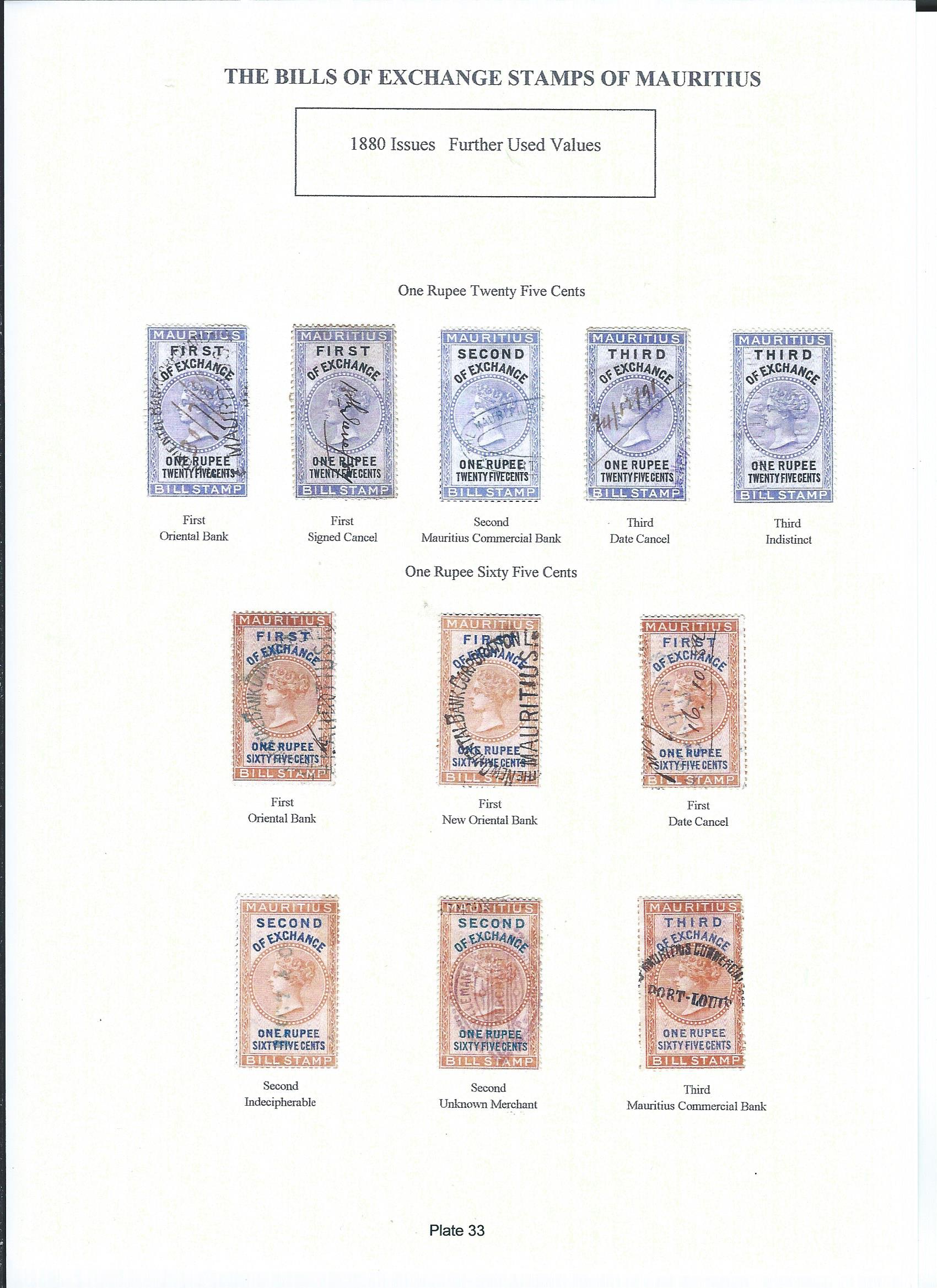
Plate 33 (click to enlarge)
The 1880 issue remained unchanged for ten years, after which there was a
complete change of colours, except for those which had already had
colour changes shown on
Plate 27. The changes took place between 1890
and 1903. As regards the higher values one rupee sixty five cents, two
rupees fifty cents and three rupees thirty five cents, these are shown
in their used form on
Plate 35. there were no changes to the perforation
or watermark from the earlier issue.
The De La Rue Appendix dated 25th September 1901 records three lower
values with colour changes. As can be seen on
Plate 36, all three
colours were printed with the ten cents value. However, only two colours
were approved with the initials “WHM” being Sir William Mercer, Chief
Crown Agent. The ten cents blue was approved “as is”, the ten cents
yellow was approved, but for the sixty five cents value, the orange
stamp was not approved. Used copies of the two approved stamps are shown
alongside.
At the turn of the century, it was decided to dispense with stamps
specifically designed separately for postage and for revenue purposes.
Thus, the rather attractive Victorian Bills of Exchange were merged with
postage stamps. The first ones to contain the words “postage and
revenue” were the three high value Arms issues of 1902.These are listed
in Gibbons as 153, 154 and 155 They could be used for all purposes,
whether it be postage, bills of exchange, insurance or internal revenue
items. All the lower values in this set, from SG 138 to SG 152 were in
the smaller Arms format and issued between 1900 and 1905 at various
times.
However, the higher values do not appear to have been used on Bills of
Exchange. Instead, on 13th November 1902, the Mauritian authorities
asked for 30,000 stamps in the doubly fugitive green shade together with
30,000 in doubly fugitive purple, all in the larger Arms size, and both
with the value tablets left blank. The green stamps were overprinted on
the island in black with the words “BILLS ONLY”, in the usual sequence
of first, second or third of exchange. The value tablet was also added
in black, and covered all eight values issued locally in 1904..
Perforation 14 was again used, as was the Crown CA watermark, although
it was sideways.The purple stamps requisitioned were not used for Bills
of Exchange, but you will see that they are referred to later on the
section covering the Insurance fiscals.
The Mauritian administration was unhappy with the fugitive nature of
both colours, but did nothing about it after complaining to the printers
and receiving a reply that this was probably due to extremes of climate
on the island. It is very hot and humid for most of the year.
These overprints seem to be more difficult to find than the earlier,
more attractive, Queen’s head issues, and a small selection of them is
shown of only three of the total of eight values used. These are all
contained on Plate 37, and the fugitive nature of the green colour is
clearly shown. There is such an immense difference between the first
four and the last three stamps that one could be forgiven for thinking
that a different colour had been used in the original printing. De La
Rue used these colours on quite a few of their printings.
Great Britain collectors will have experience of these with some of the
green and purple Victorian productions which, of course, were not
necessarily affected by the same climatic conditions that existed in
Mauritius. One can only conclude that it was poorly produced ink and
obviously had not been tested as rigorously as one would have expected.
The final illustration in this section on Bills of Exchange stamps is
shown on Plate 38. As you will see this is a Bill drawn on The Bank of
Mauritius Ltd, dated 28th April 1899, for the comparatively small value
of £10. As indicated in the Plate dialogue box, this is an unstamped
bill and, because of its date, it should have a second of exchange stamp
affixed.
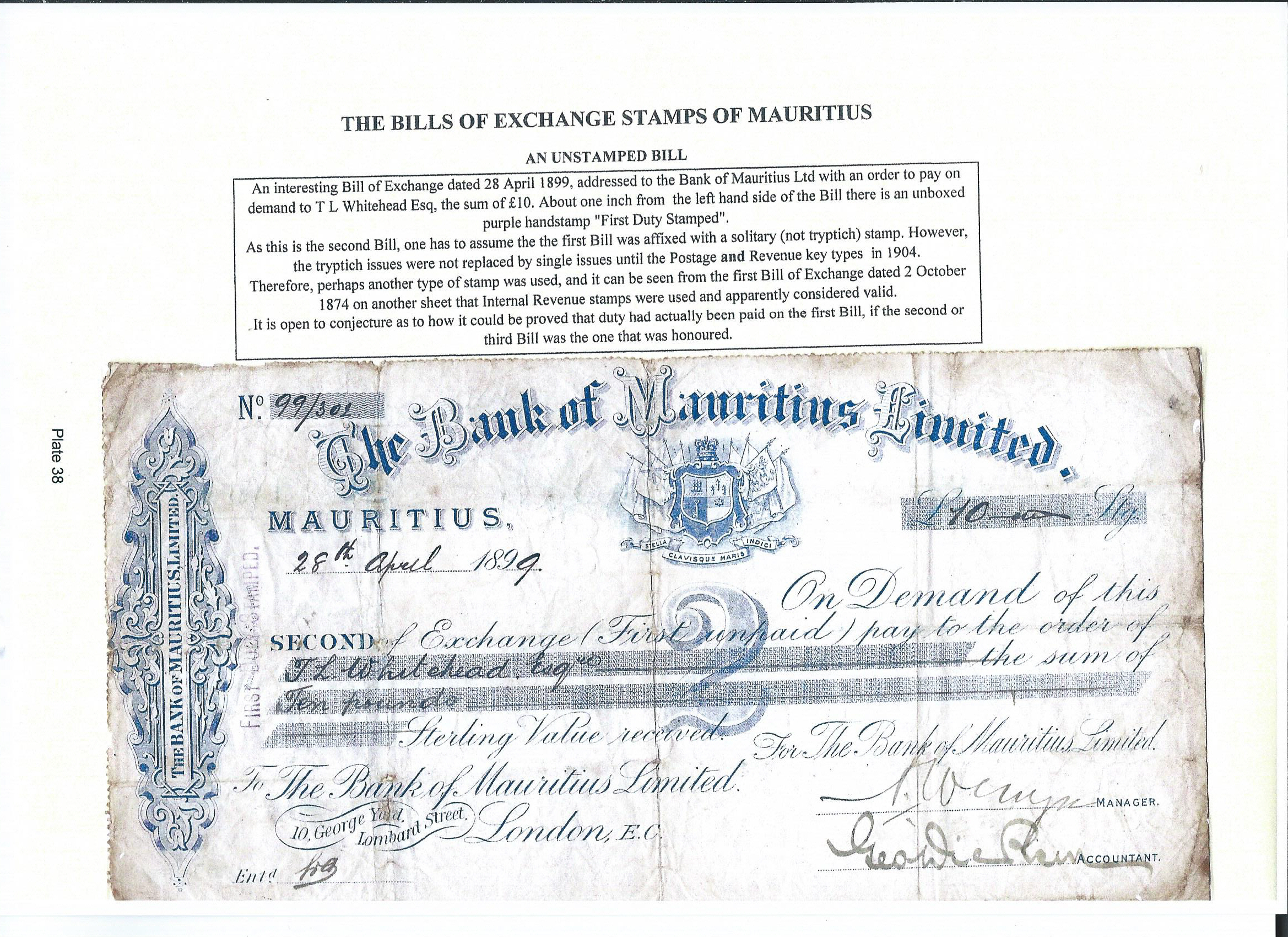
PLate 38 (click to enlarge)
But the vertical purple handstamp just over one inch from the left side
states “First Duly Stamped”, implying - I think - that no further stamp
needs to be used. Was the first Bill affixed with a different type of
stamp which exonerated the use of further stamps on the second and third
Bills? I am unsure of the answer.
In coming to the conclusion of this section, I list below brief details
of all the Bill stamps issued, catalogued as in Barefoot, together with
issue dates and quantities issued where this is known. I have not
included values. My own views on these differ quite markedly from
Barefoot, as I know what I have had to pay for some of the more
difficult stamps. I believe it is more useful for an indication of
rarity to be included, if this were possible. Dr George Wren in his
booklet “The Revenue Stamps of Mauritius” written in Ohio, USA in 1978
makes a creditable attempt at this but, again, I have to differ with
some of his conclusions. There is little doubt that the collection of
revenue stamps generally throughout the world has become more popular in
the last thirty years or so.
For these reasons, I am going to refrain from even attempting to venture
into the value and rarity fields in any great detail and to rely on the
old economic law of supply and demand; and to say that a fair price will
undoubtedly be achieved between a willing seller and a willing buyer! I
will have more to say about comparative rarity later on.
Schedule of Bills of Exchange Stamps Issued
| Barefoot Cat No |
Stamp Value and Colour | Date and Quantity of Sheets Issued |
| 1869 issue (locally printed) | ||
| 1 | 1d blue | Not known |
| 2 | 2d red | Not known |
| 3 | 4d orange | Not known |
| 4 | 6d green | Not known |
| 5 | 1s.3d brown | Not known |
| 6 | 1s.8d green | Not known |
| 7 | 3s.4d purple | Not known |
| 8 | 5s orange | Not known |
| 9 | 6s.8d olive-yellow | Not known |
| 10 | 8s.4d blue | Not known |
| 11 | 16s.8d lilac | Not known |
| 1869 issue (De La Rue printing) | ||
| 12 | 1d green and purple | Not known |
| 13 | 2d green and purple | Not known |
| 14 | 4d green and purple | Not known |
| 15 | 6d green and purple | Not known |
| 16 | 1s.3d brown and blue | Not known |
| 17 | 1s.8d brown and blue | Not known |
| 18 | 3s.4d brown and blue | Not known |
| 19 | 5s brown and blue | Not known |
| 20 | 6s.8d brown and blue | Not known |
| 21 | 8s.4d brown and blue | Not known |
| 22 | 16s.8d brown and blue | Not known |
| Note: The only despatch date known is 29 January 1872 when 256 sheets of 1d, 259 of 2d, 257 of 3s4d and 110 of 16s8d were issued |
||
| 1878 issue (new currency) Figures and words |
||
| 23 | 5c green and purple | 17.10.1877 : 251 |
| 24 | 10c green and purple | 17.10.1877 : 254 |
| 25 | 15c green and purple | 17.10.1877 : 249 |
| 26 | 25c green and purple | 17.10.1877 : 156 |
| 27 | 65c brown and blue | 17.10.1877 : 100 |
| 28 | 85c brown and blue | 17.10.1877 : 105 |
| 29 | 1r65c brown and blue | 17.10.1877 : 28 |
| 30 | 2r50c brown and blue | 17.10.1877 : 28 |
| 31 | 3r35c brown and blue | 17.10.1877 : 27 |
| 32 | 4r15c brown and blue | 17.10.1877 : 26 |
| 33 | 8r35c brown and blue | 17.10.1877 : 18 |
| 1880 issue All words |
||
| 34 | 5c green and purple | 20.03.1878 : 258 03.10.1884 : 200 03.10.1885 : 250 24.07.1888 : 200 |
| 35 | 10c green and purple | 20.03.1878 : 245 03.10.1884 : 149 |
| 36 | 15c green and purple | 20.03.1878 : 259 03.12.1895 : 305 |
| 37 | 25c green and purple | 20.03.1878 : 156 03.10.1884 : 150 |
| 38 | 35c blue and black | 06.11.1878 : 150 |
| 39 | 40c red and black | 06.11.1878 : 208 |
| 40 | 65c green and purple | 20.03.1878 : 106 |
| 41 | 85c green and purple | 20.03.1878 : 105 10.10.1889 : 41 14.03.1990 : 98 |
| 42 | 1r25c lilac and black | 06.11 1878 : 76 10.10.1889 : 56 14.03.1890 : 102 |
| 43 | 1r65c orange and blue | 20.03.1878 : 27 03.10.1884 : 25 10.10.1889 : 52 |
| 44 | 2r50c orange and blue | 20.03.1878 : 27 03.10.1884 : 25 10.10.1889 : 43 |
| 45 | 3r35c brown and blue | 20.03.1878 : 27 03.10.1884 : 10 10.10.1889 : 40 |
| 46 | 4r15c brown and blue | 20.03.1878 : 28 |
| 47 | 8r35 brown and blue | 20.03.1878 : 19 |
| 1890/1903 issue | ||
| 48 | 5c green and red | 04.04.1894 : 47 06.11.1894 : 200 18.09.1901 : 40 |
| 49 | 10c green and red | 06.11.1894 : 102 18.09.1901 : 40 |
| 50 | 10c blue and black | 14.07.1897 : 103 |
| 51 | 25c green and red | 06.08.1901 : 40 |
| 52 | 65c buff and black |
30.04.1900 : 16 18.09.1901 : 20 |
| 53 | 1r65c brown and black | 14.03.1990 : 102 |
| 54 | 2r50c lilac and black | 14.03.1890 : 83 |
| 55 | 3r.35cgrey and black | 14.03.1890 : 82 |
Generally speaking, although not entirely correct throughout, the higher the value the more expensive the stamp. This is reinforced by the smaller number of stamps printed on the higher values. For example, in the 1890/1903 issues, 203 sheets of the 5 cents were produced, whereas there were only 36 of the sixty five cents. Barefoot lists in the 2008 catalogue values for the above two stamps of £1 and £5 respectively, which is roughly not a bad comparison with print quantities. Yet the 1r65c is catalogued at £2.50 and the 2r50c at £3.50, although the print quantities are 102 and 83 sheets respectively.
I was well outbid recently on a fairly ordinary Bill of Exchange stamp, and I believe this was because it was franked with an unusual cancel in an unusual colour. Values are not easily assessed.
It is appropriate to conclude this section by listing below the names of the cancels I have seen in several albums of Bill Stamps. These cancels are worthy of collection, in addition to the stamps themselves in mint, used and ex-archive form:
-
Adam & Co
-
Alexander Duff
-
Bank Egyptienne
-
Blyth Bros
-
B S & Co (Perfin)
-
C F & Co
-
"D" (large letter in red)
-
Elias - Merchant
-
Elias Mallace (embossed)
-
Hajeed Hamode Ahoe
-
Manuscript cancels with initials and/or dates
-
Mauritius Commercial Bank
-
New Oriental Bank Corporation
-
Oriental Bank Corporation
-
Pipon Adam & Co
-
Richardson
-
Rogers & Co
Several of the above may have misspelling as, in some cases, the cancels
are partially indistinct. Where decipherable, the name is shown below
the stamp on the relevant plates at the back of this book.