Locally Printed Bills of Exchange Imperforate Stamps First Used in 1969
These were of a fairly primitive nature – even more so than the locally
engraved postage stamps which first appeared twelve years earlier, and
no Queen’s head was included in the design. I suspect that these might
have been produced as cheaply as possible to cover an urgent need before
a more presentable issue was made available from Great Britain. A used
collection of the stamps is shown on Plates
5,
6 and
7.
I have not actually seen any mint issues, although there appears to be a
black and white strip of three printed in the British Commonwealth
Revenues catalogue produced by J Barefoot Ltd.
These stamps were lithographed by E Crook of La Lithographie Coloniale,
23 Church Street, Port Louis, Mauritius. No indication is available of
sheet sizes. However, all Bills of Exchange stamps for Mauritius were
produced in triptych form within the sheet i.e. sequences of three,
described as first, second and third of exchange respectively. The
reason for this was that most Bills of Exchange were despatched by mail
and, very often, delivery was inconsistent; the missive was either lost,
burned, damaged irrevocably by seawater or stolen. The risks were great
in the middle of the nineteenth century.
I understand that, in many cases, it was usual only to send the first
and second bill by differing means, and to retain the third in Mauritius
for emergencies should one arise. I have evidence to support this view.
The first to be presented for payment would be the one which would be
honoured, irrespective of whether it was the first, second or third
stamp that was affixed. If either or both of the others arrived, they
would be dishonoured by the paying banker and no payment made.
I believe that the only other Commonwealth/Empire countries to issue
such stamps in triptych form were Ceylon (now Sri Lanka) and Seychelles.
At the time of issue, Seychelles was a dependency of Mauritius and only
Mauritian stamps overprinted Seychelles were used.
Other Commonwealth/Empire stamps did issue such stamps but not in this
form. In many cases, none were issued. Bills, in this case, either bore
no duty or other types of stamps were used, such as Revenues.
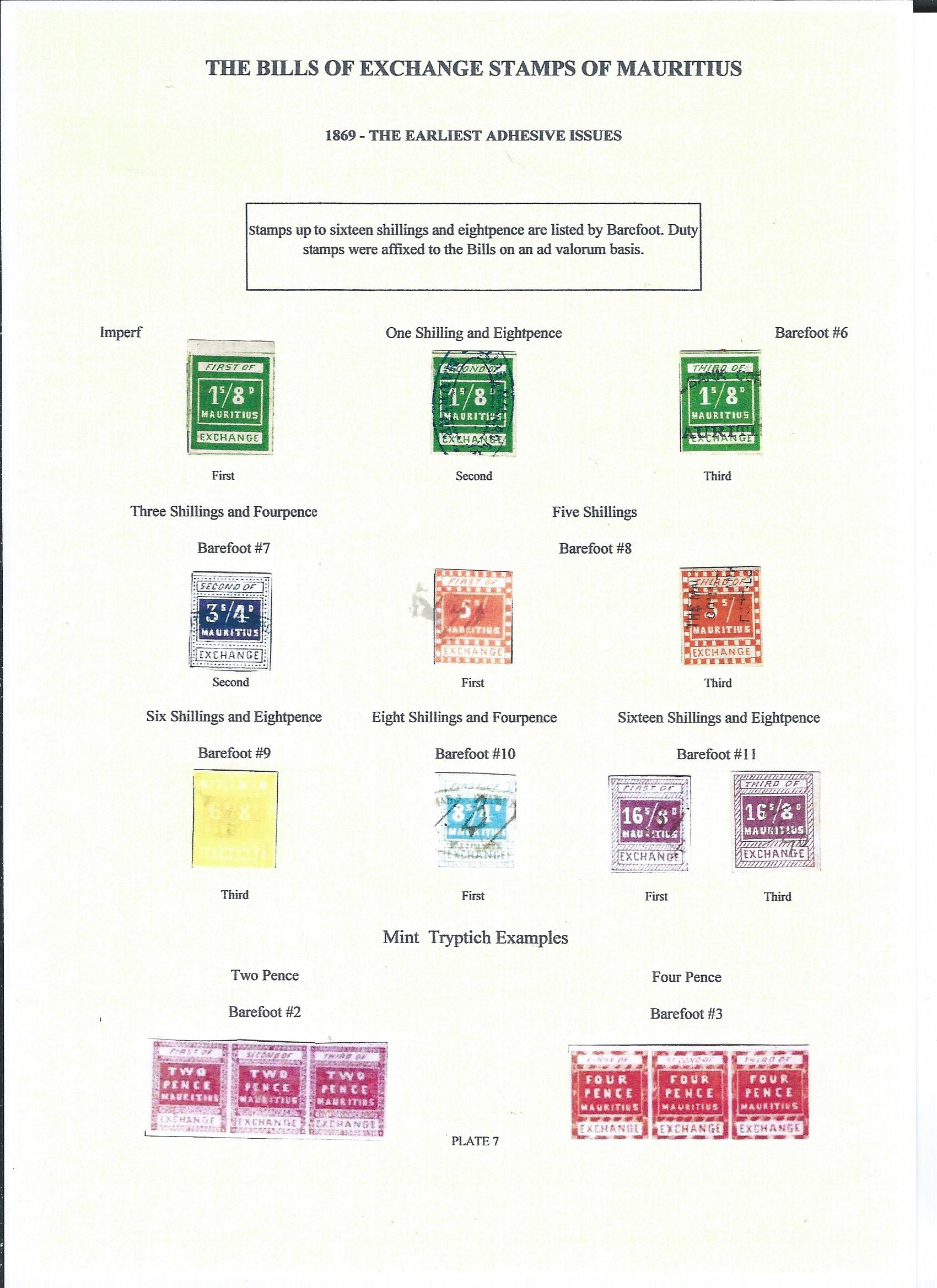
Barefoot’s catalogue lists eleven values. Plates
5,
6 and
7 show all of these in used form. Mint stamps are much rarer. The only
ones I have seen are on
Plate 7 - two se-tenant strips
of three (two pence and four pence).
A closer look at the stamps on the three plates reveals a number of
features. Firstly, only the third of exchange stamp is shown on the two
highest values of five shillings and sixteen shillings and eightpence.
These are much rarer than the lower values. Secondly, at first sight the
one shilling and threepenny pair of stamps on piece appear to be se
tenant, but in fact they are two separate stamps, both for the first of
exchange; the sequences were printed horizontally, as shown with the one
penny genuine pair with two thirds of exchange shown vertically.
Thirdly, the cancels show a variety which is interesting. Sadly, because
of the small size of the stamps, some cancels are indistinct or not
complete enough to decipher. Where this has been possible, it will be
noted that cancellation is not confined to banks, and many were drawn on
the larger commercial enterprises on the island, such as Blyth Bros who
are shown on two examples.
Plates 8,
9 and
10 display three Bills of Exchange with
stamps affixed. These are all drawn on The Oriental Bank Corporation of
London by Thomas le Chambre of Mauritius for varying values and
different value stamps as follows:-
| Value | Stamp Value |
| £1,700 | 3s/4d |
| £2,500 | 5s |
| £4,100 | 8s/4d |
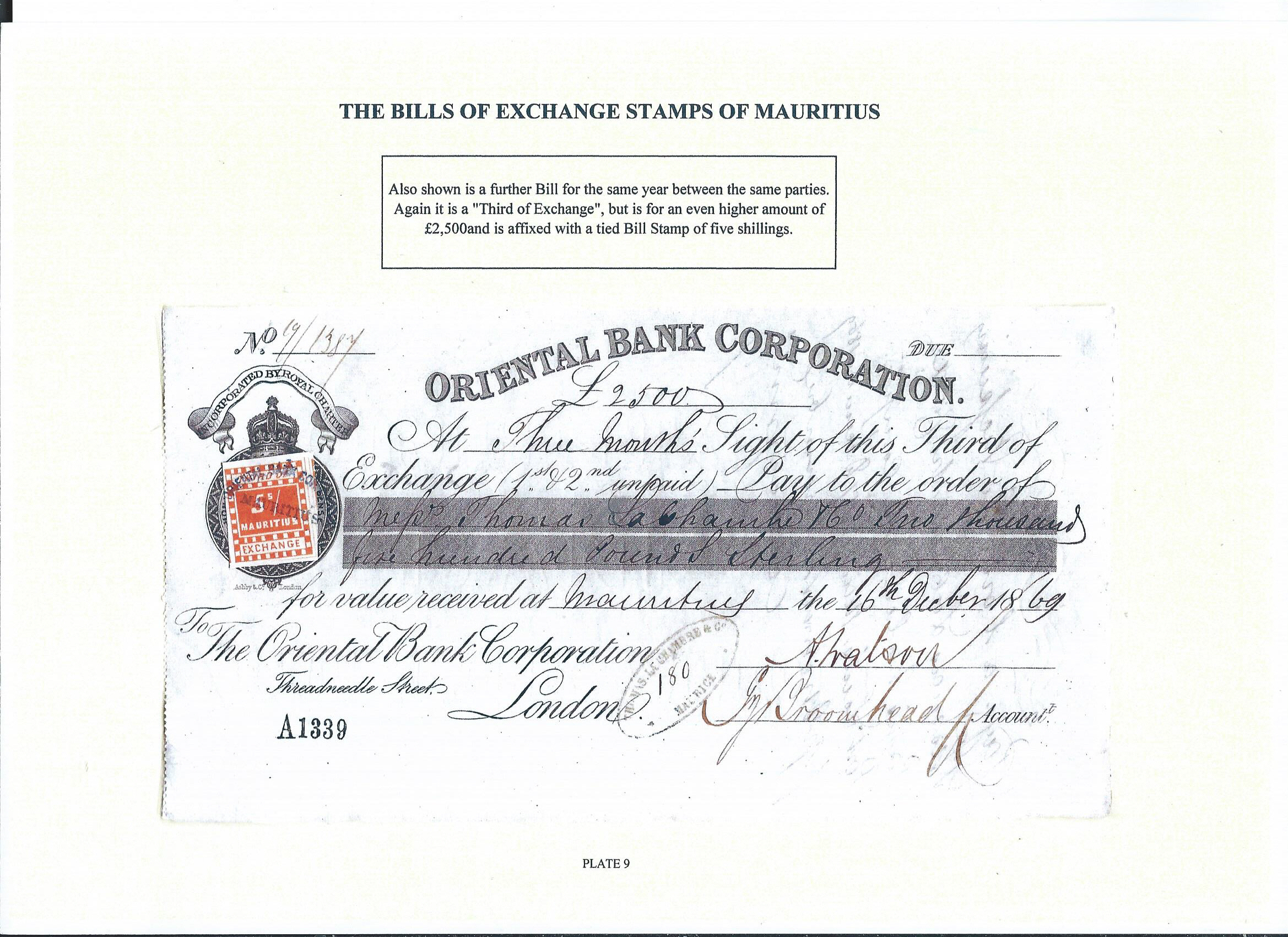
Plate 9 (click to enlarge)
| Bill Value | Type A | Type B | Type C |
| Under £50 | 6d | 3d | 1d |
| Over £50 to £100 | 1s | 6d | 2d |
| Over £100 to £200 | 2s | 1s | 4d |
| Over £200 to £300 | 3s | 1s6d | 6d |
| Over £300 to £400 | 4s | 2s | 8d |
| Over £400 to £500 | 5s | 2s6d | 8d |
| Over £500 to £750 | 7s6d | 3s9d | 1s3d |
| Over £750 to £1000 | 10s | 5s | 1s8d |
| Over £1000 to £1500 | 15s | 7s6d | 2s6d |
| Over £1500 to £2000 | £1 | 10s | 3s4d |
| Over £2000 to £3000 | £1.10s | 15s | 5s |
| Over £3000 to £4000 | £2 | £1 | 6s8d |
| Each additional £1000 | 10s | 5s | 1s8d |
Type A: Certain types of inland bills and promissory
notes, except cheques and money orders.
Type B: Foreign Bills of Exchange drawn in, but payable
out, of Mauritius, not being payable on demand, if drawn singly, or
otherwise than in a set of three.
Type C: Foreign Bills as above but drawn in sets of
three, a duty on every bill of each set. This was by far the most common
form to be used, and the only type shown here.
Currency Change. In 1878 the Mauritian currency changed to Rupees and
Cents. A separate table is shown later in this book which shows the
revised duty payable.
All the catalogues of revenue stamps (with the exception of Barefoot)
list the 2d, 4d, 1s3d, and 1s8d as being available on thin paper, and
the 16s8d on blue paper.
2d (one example) 0.109mm to 0.112mm
4d (one example) 0.095mm to 0.101mm
4d (two examples) 0.063mm to 0.068mm
6d (one example) 0.091mm to 0.094mm