Postal Orders
The Imperial postal order system was adopted in the British Empire in
circa 1905. In those days very few people, apart from the wealthy and
businesses, had bank accounts. Wages were generally paid entirely in
cash. Prior to the introduction of the postal order, it was difficult
for most people to settle their debts otherwise than by passing on some
of their earnings - in other words by cash and in person. Sending cash
through the post had its risks, even when registered.
So the introduction of the postal order was a solution to many
obstacles. However, it could be expensive to use in certain
circumstances, because of the ad valorem duty levied on the instrument;
but in some instances it was much cheaper than using a cheque. In a
recent letter I have seen from the Mauritius High Commission in
Canberra, Australia, requests to Port Louis for official copies of
birth, death, marriage or divorce certificates have to be accompanied by
fees. For a single document, a £7 postal order was sufficient, but a
cheque would have to be drawn for £19 due to bank charges being levied.
The postal order would have to be bought from a post office, and would
cost rather more than £7 because of the duty mentioned in the previous
paragraph, but this would be small when compared with the cheque for
£19. However, in most cases it would be cheaper to send a cheque.
The illustration at the top of
Plate 96 shows a copy of
a British postal order for six pence. The revenue stamp is printed on
the order at top left, but it is overprinted "Poundage payable in
Mauritius - 15 cents". The stamp bears the head of King George VI.
Bottom left is the round handstamp of the Port Louis Mauritius post
office from where the order was purchased. At this time and, indeed
later into the reign of Queen Elizabeth II, many of the colonial orders
were printed in Great Britain, and headed across the top centre with the
words "British Postal Order", below which was overprinted the name of
the colony and the poundage charged locally.
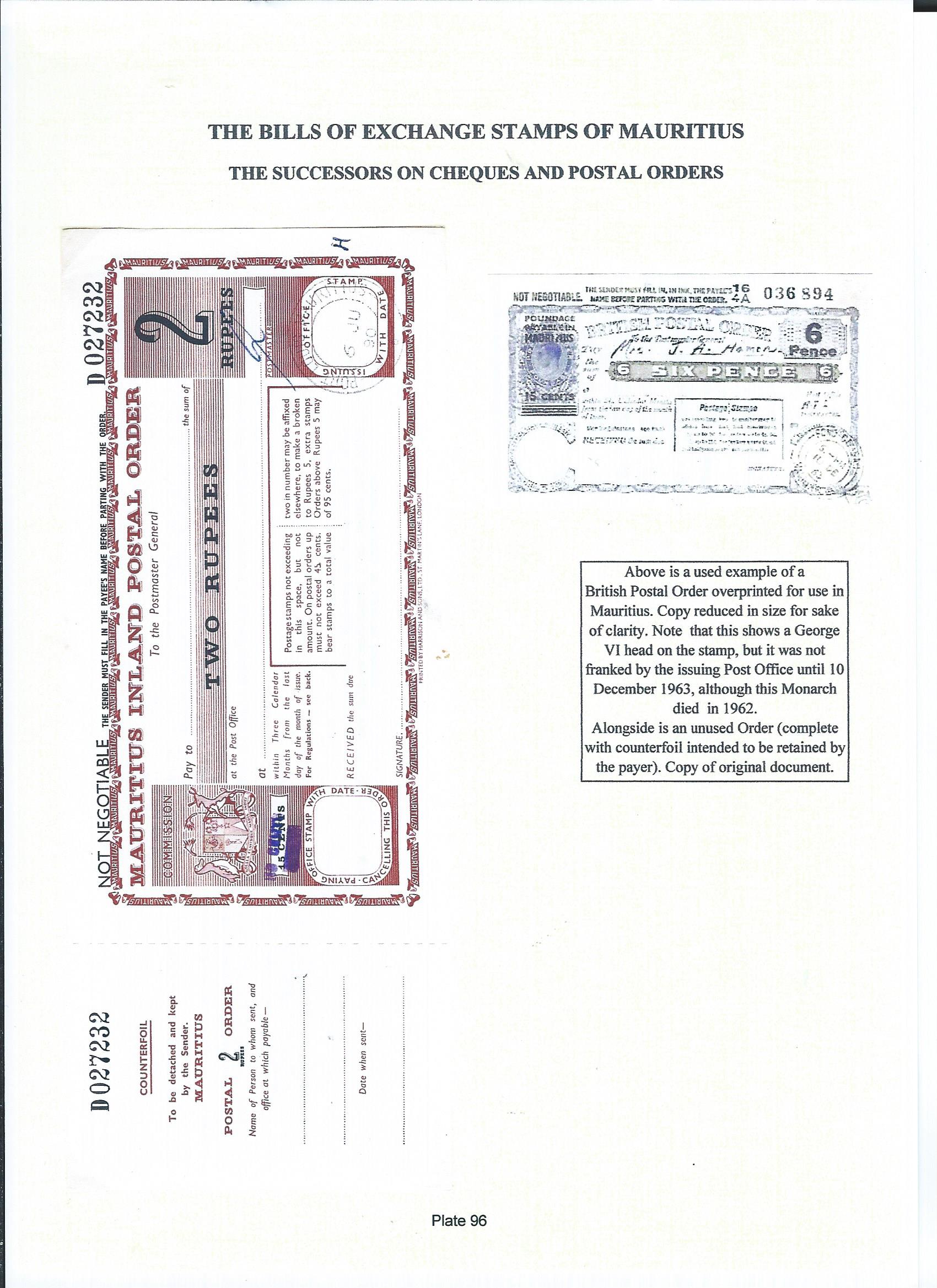
Plate 96 (click to enlarge)
"Poundage" is an interesting word to examine. It is used in Great
Britain to describe the duty charges on postal orders. It was originally
used as long ago as 1347 to describe customs duty on both imports and
exports at a rate of one shilling for every pound of goods imported or
exported. It is unclear as to whether the word "pound" related to weight
or Sterling: also as to why "Poundage" was specifically subsequently
attributed to postal orders, but no other form of contemporary duty.
At the extreme top left of the order, the words "not negotiable" appear
as part of the original printing. This is not always strictly correct.
It only applies if the order is made out to a specific payee, as it is
in the first example on
Plate 96. In this instance, the
postal order cannot benefit anyone else, and has to be paid into the
payee's bank account, or encashed at a post office on producing evidence
if title.
The second example on
Plate 96 shows an unused postal
order for two Rupees, with counterfoil attached. This entirely
negotiable, as the payee is not shown, and can be encashed at any post
office by the holder - or indeed paid into his or her bank account. This
order was franked and issued by the Port Louis post office on 6 June
1990. It will be seen that this is a Mauritius document rather than a
British one overprinted "Mauritius". It was issued after the island's
independence, and the Queen's image has been replaced by the Mauritian
coat of arms. The description "Poundage" has been replaced by
"Commission". Printed by Harrison's the British security printers, it is
locally overprinted on the 45 cents commission tablet by a purple
handstamp "50 cents".
Doubt has been expressed in some quarters as to whether the levy on a
postal order, by whatever name it is called, is a legitimate revenue
item. I have to agree that it does not conform to the common description
of a stamp, although even this tends to change as technology moves
onwards. However, there can be no doubt that the levy is a revenue
charge. In my opinion postal orders should be included.
Because postal orders were printed only for a set of specific sums, one
may wonder how flexible they are in practise. If one refers to the two
Rupee example, if one wanted to send a remittance of (say) two Rupees 40
cents, one could merely add up to two postage and revenue stamps for a
total of 40 cents affixed to the boxes provided below the centre of the
order. The value of the stamps would be restricted to no more than the
value of the next higher value postal order, in order to prevent
escaping additional levy.
Postal orders are now declining in use, in the move towards cheques, and
onwards to the predicted cashless society.