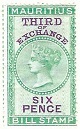
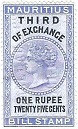
Stamps Printed by Thomas de la Rue Ltd in Great Britain
from 1869 Onwards
Insurance StampsOne could be forgiven for thinking that insurance tax might be a fairly recent innovation, as it certainly is in Great Britain, where it was introduced as yet another "Stealth" tax around the beginning of the 21st Century. Mauritius made use of insurance stamps for tax purposes as far back as about 1860. As far as I am able to trace from a fairly rapid examination of the Barefoot catalogue, only the following Commonwealth/Empire nations were involved in stamp issues of a similar nature:-
-
Burma
-
India
-
Malaya (Straits Settlements) on marine policies
-
Pakistan
-
South Africa (Cape of Good Hope)
As with Cape of Good Hope, all Mauritian insurance
stamps were overprints on stamps used for other purposes. Insofar as
Mauritius was concerned, they were overprints originally on postage
stamps and, subsequently, internal revenue issues.
The tax charged was mandatory on all life policies and represented ad
valorem duty of one shilling per £100 (and 50 cents per 1,000 rupees
after the currency change).
Insurance on ships and cargo and land on fire risks on land-based assets
were subjected to duty of three pence per £100 (latterly 13 cents per
1,000 rupees). Evidence exists that this was increased to 15 cents at
some time during the twentieth century.
"Insurance" is a general term used to describe any contract concerned
with any of the above indemnities. Strictly speaking it is incorrect to
do so, as there is an essential difference between "insurance" and
"assurance". The term "Insurance" refers to providing cover for an event
that might happen, while "assurance" is the provision of cover
for an event that is certain to happen.
Thus, fire insurance might happen, but life assurance
has to happen, because death is inevitable at some point in time. So the
former can be interpreted as a protection, whereas the latter can be
seen as a form of savings to assist the bereaved. There are some
exceptions to the assurance rules - such as endowment policies, but
these complications need not bother us. Most, if not all, of the stamps
subsequently illustrated and described in this book probably relate to
insurance rather than assurance.
Pre-stamp insurance existed but, as far as one can trace, it was not charged to duty. However, the tragic consequences of the Great Fire of Port Louis on 25th September 1816 ( illustrations from a French newspaper on Plates 66 and 67) show how devastating great disasters can be, and would make commercial and private property owners more aware of the need for insurance.
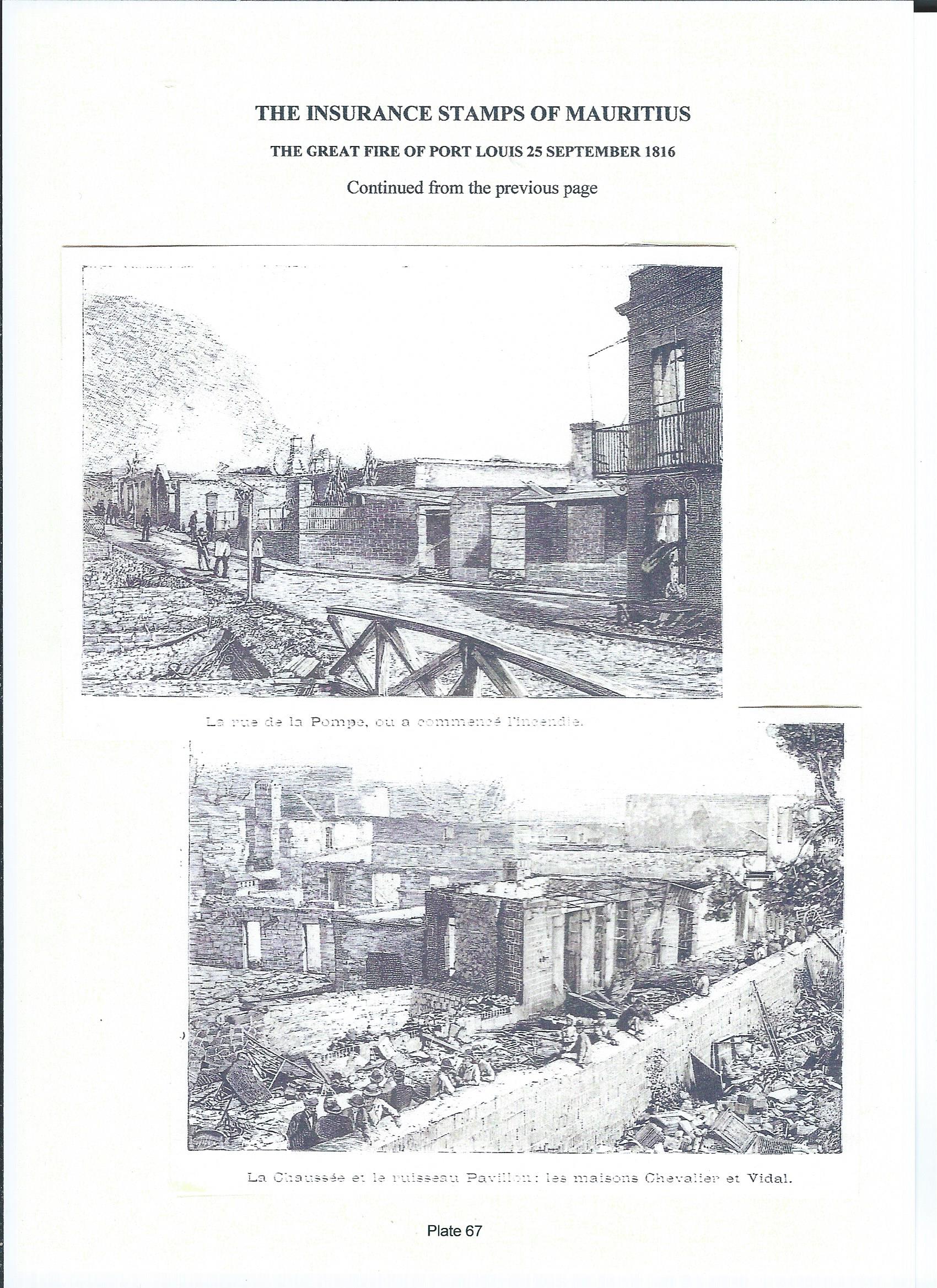
Plate 67 (click to
enlarge)
It is therefore somewhat of an anomaly that countries should choose to
tax prudence particularly when, in the event of uninsured tragedy, the
appropriate government is expected to pick up the tab!
Along with the Bills of Exchange and Internal Revenue stamps, the first
Insurance items were issued in 1869. No specifically designed stamps for
this category were ever printed. They were all overprints of various
kinds.The first ones to appear were postage stamps which were
overprinted with a locally-produced handstamp which merely stated
"INCE". The stamps used were some of the Victorian issues of 1860 and
1863/72, according to Gibbons, but Barefoot describes all as 1860/65.
Also, the colour variations differ between the two catalogues as
follows:-
| Barefoot Cat. No value and colour | Gibbons Cat. No value and colour |
| #1 3d red | #63 3d deep red |
| #1 3d red | or #63a dull red |
| #2 6d green | #65 6d dull green |
| #3 9d purple | #51 9d dull purple |
| #4 1s yellow | #68 1s yellow |
| #4a 1s yellow (o/print inverted) |
#68 1s yellow |
| #5 5s purple | #71 5s rosy- mauve or71 5s bright mauve |
With the exception of #51, Gibbons lists all values also with inverted
watermarks. In the case of #65, it also lists it with watermark reversed
and watermark inverted and reversed. None of these appear in Barefoot,
who state "We do not normally list accidental watermark inverted and
reversed varieties; they are only listed in a few cases where there has
been a planned and consistent change by the printers".
It is therefore possible that watermark varieties may exist on the above
issues and, indeed, on all the other Revenue stamp issues Barefoot lists
on Mauritius.
The remaining stamps in the Insurance section are
all various overprints on original Internal Revenue issues.
Plate 68 shows one example of the handstamp overprint
on a postage stamp. The rest of the Plate displays the lower values in
Sterling on the 1869/72 Internal Revenue stamps: this is followed on
Plate 69 with the higher values, together with
additional denominations created in 1874. All are handstamped.
The change in currency in 1878, necessitated an overall review of all
Mauritian stamps, and the Insurance issues were no exception. The
authorities decided to replace handstamps with overprints, but still
used the old Sterling Internal Revenue issues. These are shown on
Plates 70 and
71. Still using the "INCE" abbreviation
on the overprint, there are variations in the size of the "IN". On some
stamps this is 9mm tall, and on others it measures 6mm. In some cases
both lengths have been used - not on the same stamp I hasten to add.
Where the lower length is used then two lines below the new value which
obliterate the old Sterling value are thinner.
Further down this section, as with other Revenue stamps, I have again
listed the complete Barefoot catalogue numbers of the Insurance stamps,
which will indicate the varieties, including one where three
obliteration lines have been used.
In 1879, there was a reversion to the old handstamp type, merely for one
stamp. This was for a 50 cents (no overprint value necessary - just
"INCE") yellow and black Internal Revenue stamp. I have not seen this in
colour, and it is therefore not shown on a Plate.
We now proceed to overprints of a more sophisticated style, and I start
with part of Requisition 4413, via the Crown Agents for the Colonies to
De La Rue and from their archives, related entirely to the Insurance
stamp needs. This is displayed on Plates
72,
73 and
74.
It is interesting to see that the Requisition does not specify that the
value overprints should be replaced by values in the value tablets,
although this was carried out. However, it does say on
Plate 74
"with the word INSURANCE engraved in full on each label".
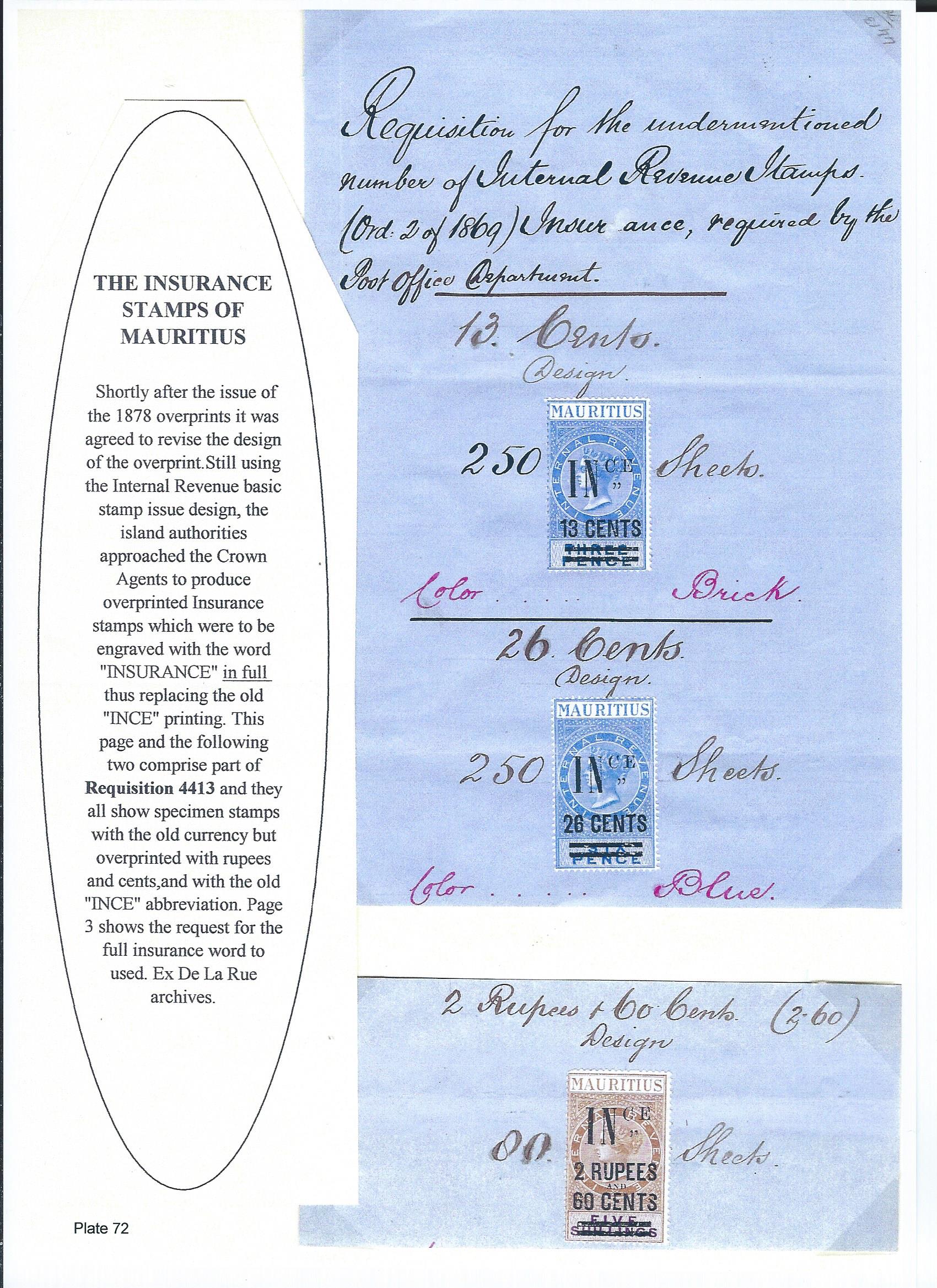
Plate 72 (click to
enlarge)
There are some variations in the colour of the finally-produced material
and the Requisition, as can be seen from Plates
75 and
76
which display all values except the 50 cents blue and blue, and is
comparatively rare according to Barefoot valuations. At the foot of the
last Plate there are a couple of pieces cut from policy documents.
Although there is no indication from the fragments of printing shown on
the perimeters surrounding the stamps, at the rate of 13 cents per 1,000
rupees, they come from insurance policies giving cover of 25,000 and
9,000 rupees, probably against fire.
One of the finest Mauritian documents I have ever seen is a whole
insurance policy from The Colonial Fire Insurance Company. In size, the
document covers about four A4 pages. To condense it in size to one sheet
would make it virtually unreadable and, therefore, I have reproduced it
on four separate exhibits. Plates
77,
78,
79, and
80.
The printing is in two colours and the manuscript is impeccable. On
Plate 77, one can see the two 1879 Insurance stamps
with denominations of five rupees 20 cents and fifty two cents: cover is
for assets of 44,000 rupees. The only part of the document which is
covered is the short typed description on the first Plate. If desired,
it should be possible for the reader to copy all four plates and put
them together to read or display most of the whole document.
The next sheet,
Plate 81, is a set of colour trials
from De La Rue. All the value tablets are printed with "thirteen cents",
but in different colours. The intended values are written in manuscript
on the left hand side of each stamp. None of these were eventually
adopted.
Insurance overprints were produced as late as 1904. This time the
authorities used the large type purple "arms" issues of 1900-5, which
were the first Mauritian issues to be printed integrally with "postage
and revenue". The value tablets were initially blank, and the stamps
were then overprinted in black with the words "INSURANCE ONLY" together
with the appropriate values. Overprints vary, and are described in
detail on Plate 82.
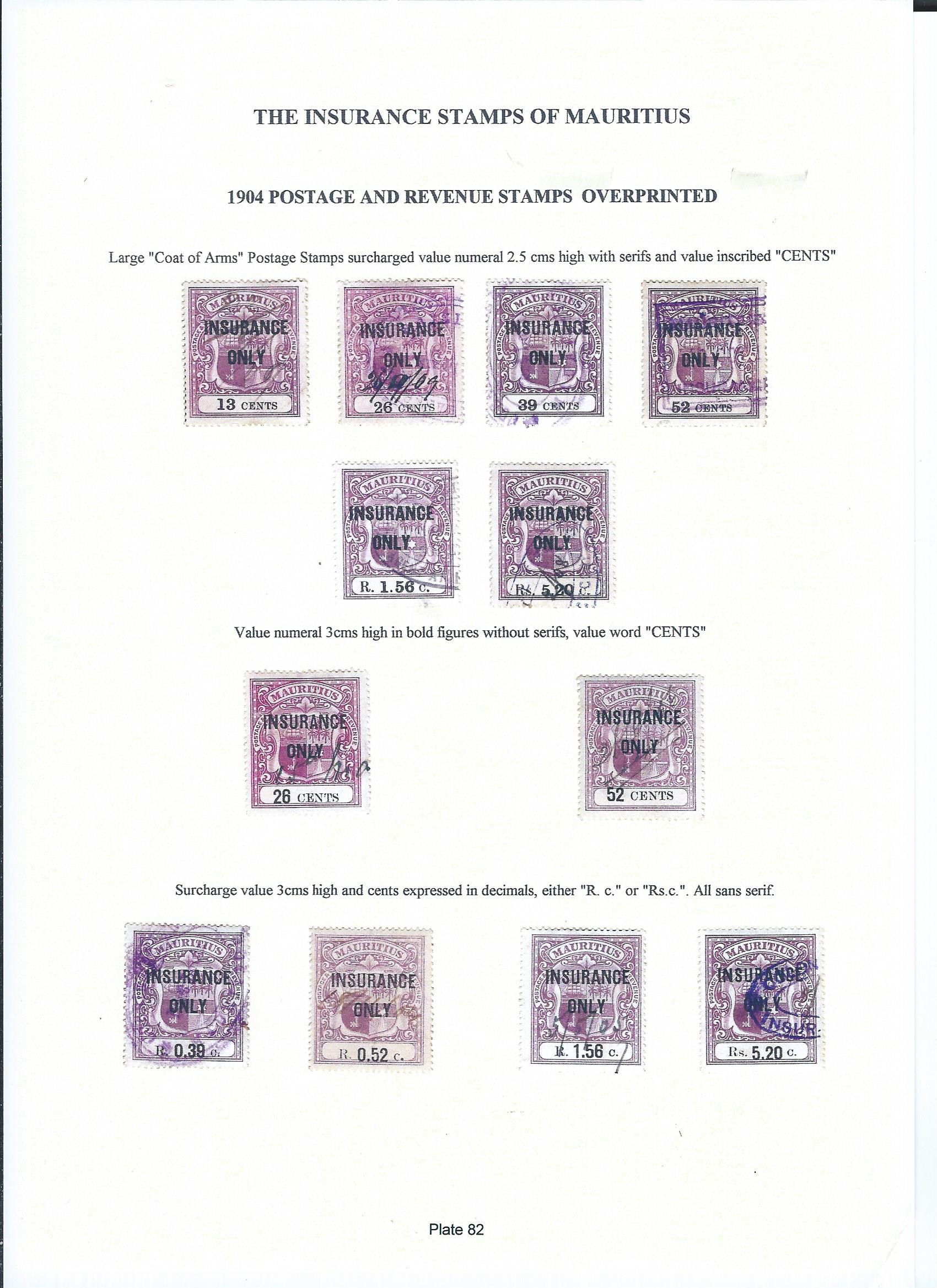
Plate 82 (click to
enlarge)
After the above issue, such policies were taxed by affixing postage and
revenue stamps to the document and, therefore, "pure" insurance stamps
ceased to be used.
| Schedule of Insurance Stamps Issued | ||
| Barefoot Cat. No | Stamp Values and Colour | Date and Quantity of Sheets Issued |
| 1869 Postage Stamps of 1860/65 handstamped INCE | No data available until the 1878 issues. |
|
| 1 | 3d red | |
| 2 | 6d green | |
| 3 | 9d purple | |
| 4 | 1s yellow | |
| 4a | overprint inverted | |
| 5 | 5s | |
| 1869/72 Internal Revenue Stamps handstamped INCE |
||
| 6 | 3d blue and blue | |
| 6a | overprint diagonal | |
| 7 | 6d blue and blue | |
| 7a | overprint inverted | |
| 8 | 1s brown and purple | |
| 9 | 2s brown and purple | |
| 9a | overprint inverted | |
| 10 | 3s brown and purple | |
| 11 | 4s brown and purple | |
| 12 | 5s brown and purple | |
| 13 | 10s brown and purple | |
| 13a | overprint inverted | |
| 14 | £1 mauve and brown | |
| 14a | overprint inverted | |
| 14b | overprint double | |
| 1874 As above except Watermark Crown CA instead of Crown CC |
||
| 15 | 6d blue and blue | |
| 16 | 1s brown and purple | |
| 17 | 2s brown and purple | |
| 1878 internal Revenue Stamps of 1869 overprinted with new currency and INCE |
||
| 18 | 13c on 3d blue and blue | 06.11.78 : 255 |
| 19 | 1R56c on 3s brown and purple | 06.11.78 : 102 |
| 20 | 2R8c on 4s brown and purple | 06.11.78 : 76 |
| 21 | 2R60c on 5s brown and purple | 06.11.78 : 81 |
| 22 | 10R40c on £1 mauve and brown | 06.11.78 : 32 |
| 23 | 26c on 6d blue and blue | 06.11.78 : 250 |
| 23a | three bars in overprint | N/A |
| 24 | 39c on 1s brown and purple | 06.11.78 : 201 |
| 25 | 52c on 2s brown and purple | 06.11.78 : 259 |
| 26 | 5R20c on 1s brown and purple Note: The value shown by Barefoot against #26 is 5R50c. I have not seen this value, but believe it should be 5R20c, as shown by Ibbotson. |
06.11.78 : 41 |
| 1879. Internal Revenue Stamps of 1879 handstamped INCE |
||
| 27 | 50c yellow and black Not known | |
| 1879. Similar Stamps but overprinted INCE |
||
| 28 | 13c orange and black | 03.10.84 : 104 10.10 89 : 62 21.03.93 : 86 25.06.94 : 104 14.07.97 : 100 18.09.01 : 100 |
| 29 | 26c blue and black | 03.10.84 : 97 10.10.89 : 62 24.07.88 : 80 15.12.92 : 84 25.06.94 : 104 08.05.96 : 50 14.07.97 : 150 30.04.00 : 32 18.09.01 : 100 |
| 30 | 39c purple and black | 03.10.84 : 100 24.07.88 : 80 10.10.89 : 61 21.03.93 : 85 25.06.94 : 104 14.07.97 : 102 |
| 31 | 50c blue and blue | Not known |
| 32 | 52c red and black | 03.10.84 : 102 24.07.88 : 80 15.12.92 : 84 10.10.89 : 64 25.06.94 : 202 14.07.97 : 500 06.08.01 : 80 18.09.01 : 100 |
| 33 | 1R56c green and black | 10.05.86 : 100 30.04 00 : 22 06.08.01 : 20 |
| 34 | 2R8c blue and black | 10.05.86 : 51 10.10.89 : 65 |
| 35 | 2R60c yellow and black | 10.05.86 : 50 10.10.89 : 61 28.06.99 : 20 30.04.00 : 22 |
| 36 | 5R20c orange and black | 10.10.89 : 61 |
| 37 | 10R40c mauve and black | 10.10.89 : 61 |
| Note:- I have not seen copies of either #27or#31, although Ibbotson has seen #31.These stamps were probably overprinted by De La Rue as the overprint letters are 4mm high, but 5mm on the De La Rue issues. They were probably prepared locally, although the reason is not known, and no issue numbers are known. | ||
| 1904. Postage types surcharged in black. Numbers 2.5mm high with serifs. |
||
| 38 | 13c purple | No data available |
| 39 | 26c purple | |
| 40 | 39c purple | |
| 41 | 52c purple | |
| 42 | 1R56c purple | |
| 43 | 2R08c purple | |
| 44 | 2R60c purple | |
| 45 | 5R20c purple | |
| 1904. Similar with numbers 3mm high bold without serifs. |
||
| 46 | 13c purple | No data available |
| 47 | 26c purple | |
| 48 | 39c purple | |
| 49 | 52c purple | |
| 1904. Similar | ||
| 50 | 13c | No data available |
| 51 | 26c | |
| 52 | 39c | |
| 53 | 52c | |
| 54 | 1R56c | |
| 55 | 2R08c | |
| 56 | 2R60c | |
| 57 | 5R20c | |
Handstamped cancels are to be seen on all the above issues. These are more difficult to identify than those on other revenue stamps mainly because of the intrusion of the overprints on values etc., which apply to all of them. The latter issues, which are all in purple with black overprints, are even more difficult to decipher.
The following list is the best I can achieve:-
-
Adam & Co
-
Blyth Brothers & Co
-
Colonial Fire Insurance Company
-
Corrie Fisher
-
Mauritius Fire Insurance Company
-
M.F.I.C. (abbreviated from the above)
-
Scott & Co
One could be forgiven for wondering how the stamps
of Adam & Co and Blyth Bros could appear on insurance stamps as they
were not insurance companies. In researching the history of the two
firms it is evident that they were the major traders and shipping agents
on the island. Blyth Bros realised that considerable profits be gained,
with little effort, by becoming insurance agents, and they negotiated
agencies in 1836 with the Equitable Insurance Company for insurance
against goods, and with the Phoenix Insurance Company against fire.
These brought in substantial commissions and enabled the company to
issue policies cancelled with the Blyth Bros cancel on the stamps.
Adam and Co recognised the advantages of such business and negotiated
similar deals. For the collectors of Mauritian postal history, it is
interesting to note that Blyth Bros became agents for the Messageries
Maritimes which started in 1864 through to 1980.