Stamps Printed by Thomas de la Rue Ltd in Great Britain
from 1869 Onwards
Inland
Revenue and Postage & Revenue Stamps
The Inland Revenue stamps only comprised four
separate issues, but spread over a period of nine years from 1889 to
1898. In December 1888, Mauritius required, urgently from De La Rue, a
supply of 700,000 4 cents stamps. In order to comply with this
requisition as soon as possible, De La Rue suggested that it could
overprint a postage stamp with the words "Inland Revenue". The stamp to
be used was the Victorian 4 cents issue (later to be listed by Gibbons
as Type 19) but, instead of its original colour of orange, in
doubly-fugitive purple or lilac; the overprint would be in black, up and
down the sides of each stamp, in sans-serif style.
Mauritius accepted this compromise for expediency, thus avoiding delays
with correspondence taking so long each way. Although telegraphic
communication was possible by then ,there was no way that a copy of a
stamp could be conveyed other than by ship. It appears that the stamps
were supplied and an invoice issued on 25 February 1889. The invoice
shows 2995 sheets, each of 240 stamps, making a grand total of 718,800
items.
Along with other doubly-fugitive stamps supplied by De La Rue, Mauritius
was not particularly happy with the rapidity by which the colours faded.
The printers said that this was due largely to the hot and humid climate
experienced on the island, and it appears that the authorities accepted
that this was the case. It does not account for the same thing happening
in Great Britain with its relatively cool climate and lower humidity.
De La Rue also printed the four cents stamp in carmine ( see Gibbons
#105) for postage purposes in 1885. This was used to produce further
overprinted Inland Revenue issues. This time, the overprint was
horizontal, again in black, but the letters had serifs. Ibbotson takes
the view, and I have seen no evidence to dispute it, that these
overprints were done locally, as the letters used were very similar to
those used on the local Two Cents postage stamp surcharge of 1891 (see
SG 118-121).
One wonders whether these latter stamps were produced to be used in
place of the doubly-fugitive earlier issues before they were used up. I
think that this is a doubtful guess because the next pair of Inland
Revenue stamps were printed in purple/lilac and in green, both of which
were doubly-fugitive.
They were invoiced by De La Rue at eight dates between 1891 and 1898,
and altogether totalled 20,834 sheets of 120, making a total stamp issue
of 2,500,080. It is thought that only the last batch invoiced on 25
January 1898 for 2,989 sheets were in green, but this is not absolutely
certain.
The first three Revenue stamps are listed by Gibbons as "Fiscals used
for Postage", but the final green stamp does not appear at all.
Presumably because it was only used fiscally.
Plates 83 and
84 display all of the Inland revenue
issues: the first one shows them in mint blocks and the second comprises
all used items. On the latter plate there is a postally-used four cents
mauve/lilac with a B53 (Mauritius) barred oval cancel.
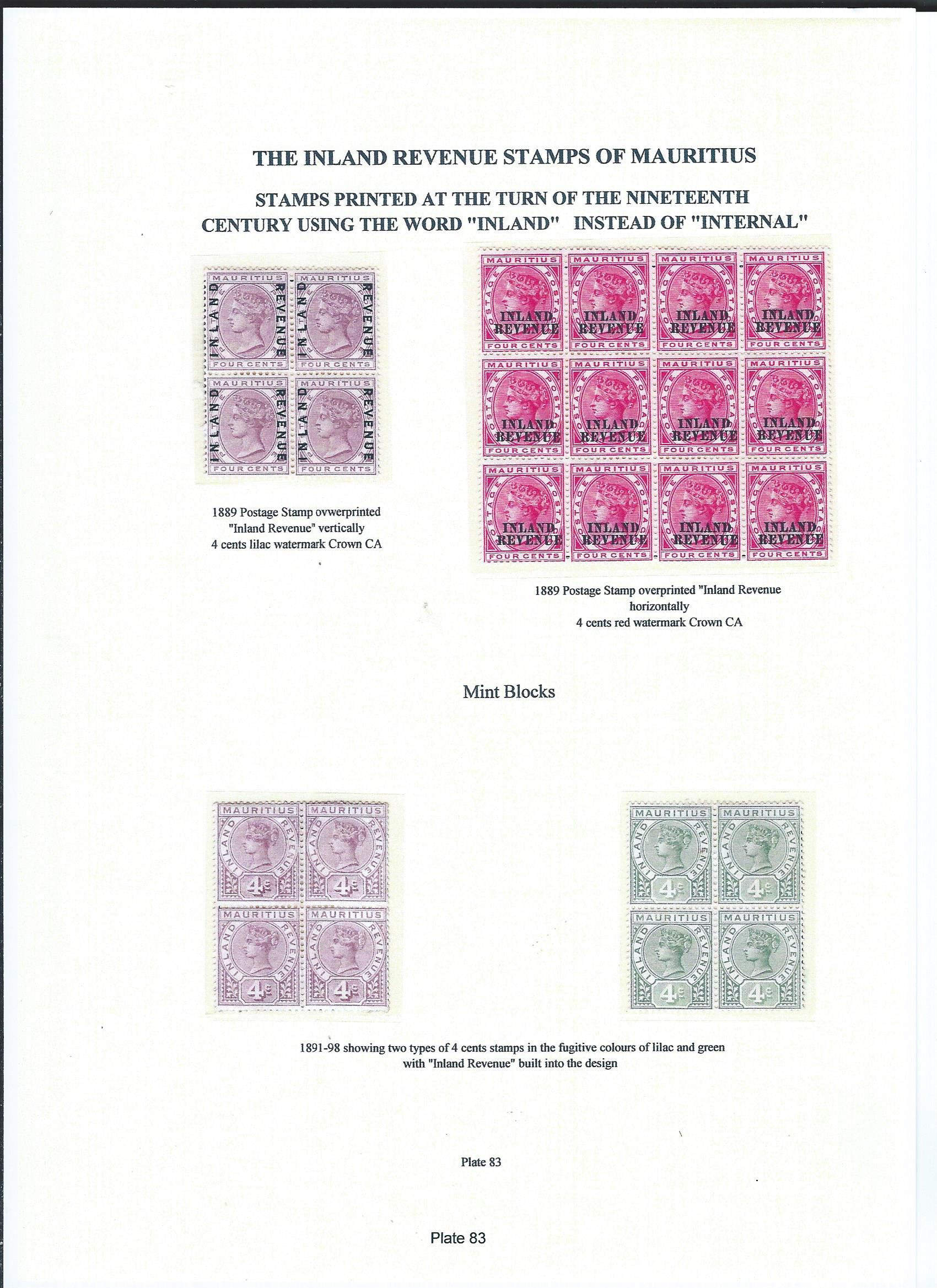
Plate 83 (click to
enlarge)
I now turn to the second part of this section, which is to discuss the
usage of the Postage and Revenue stamps which were commonly issued from
1902 onwards. This meant that all adhesives from then on would be dual
purpose. Consequently, in theory, one could collect all stamps from the
above date as revenues if one could prove that they were used for fiscal
purposes.
What I propose to do is merely to illustrate a few of the more important
aspects of some of the |De La Rue products from the earlier part of the
twentieth century. Collectors can then make their own decisions as how
far or how little they extend their collections fiscally as opposed to
postal use.
I stress that it is comparatively easy to find fiscal issues earlier
rather than later, as fiscals have tended to be replaced by other means
as the years have rolled on. For example, insurance tax, where it is
still collected, is usually added to the premium, and paid by cheque,
credit card or bank transfer of some kind.
The easiest manner to identify a fiscally-used stamp is by the purple
colour of its cancelling handstamp which often includes the name of the
firm. Also, one can find manuscript cancels, although I have seen these
on postally-used stamps.
An example of a study of one particular issue is shown on
Plate
85 which deals exclusively with the Edward VII definitive grey
and carmine SG 185. There are seven stamps shown, extracted from a
selection of about 200-300 of the same issue. Three of these are
cancelled by the Mauritius Commercail Bank, but the actual handstamps
have different qualities. Two are large ovals, but one of these is in
red which is quite rare. The third is a small oval. The Bank odf
Mauritius is shown on the next two, one with a date and the other with
the separate additional handstamp showing an amount. Many of these five
cents issues were for duty on cheques. The final two are Adam & Co
cancels with and without dates, the second having a double outer ring.
An interesting study can be made of the very high value fifty Rupees
large arms type issued in 1924, and listed by both Gibbons (SG 222) and
Barefoot. Previously, there had been no value stamp issued by Mauritius
over 10 Rupees and. therefore, this was a great leap. Although the stamp
had relevance as a revenue issue, the possibility of postal use was
remote. A letter would have had to weigh more than five kilos and a
parcel a great deal more. Nonetheless, Gibbons have listed it postally
used, although one wonders whether this was done for philatelic purposes
alone. Personally, I have never seen a genuine 50 Rupees stamp used for
postage which has been dertified as such, although some undoubtedly
exist: this is reinforced by Gibbons putting a value on a used version
of nearly three times that of a mint stamp.
Plate 86 shows plate proofs in black from the De La Rue
daybook of the frame and the duty tablets in black. This was cancelled
as is evidenced by the red diagonal line. On the plate , there is also a
mint copy and mint overprinted "Specimen". These are in the accepted
colours ,one of which again appears to be the doubly-fugitive ink used
earlier. The number plate is in green, but this does not appear to be
fugitive. If one turns to
Plate 87 there are further
examples of SG 222. The first is supposed to be postally used, although
no "genuine" certificate exists at this time. The second one has a
purple date stamp. The horizontal stamp has been affixed vertically, and
this appears to be a genuine fiscally used stamp.
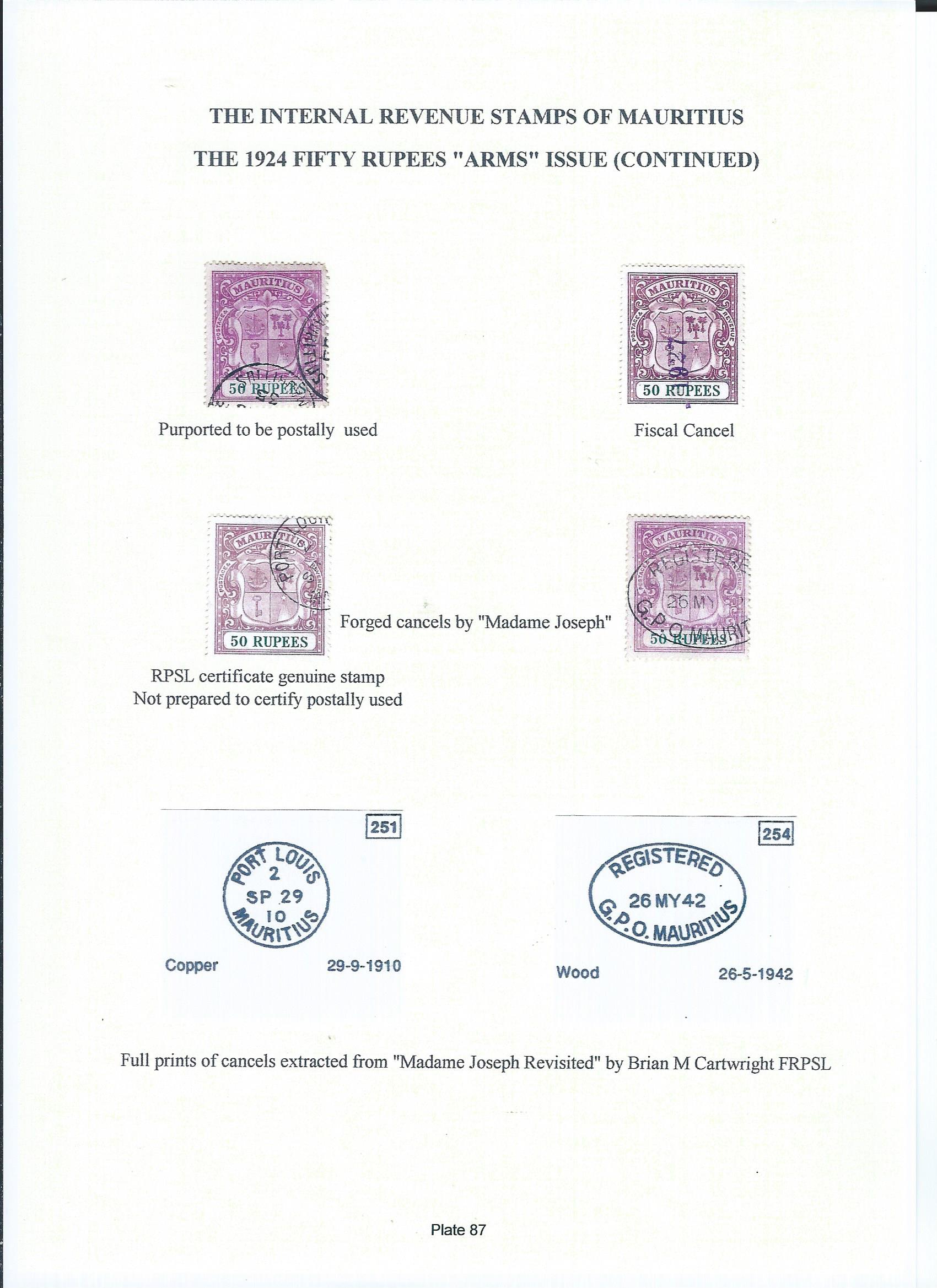
Plate 87 (click to
enlarge)
We then come to the last two, which are described as "forged cancels by
Madame Joseph". The first shows some fading, as one might expect with
the mauve/violet colour, while the second is about right as far as the
shade is concerned.
The first of these has a Royal certificate stating that the stamp is
genuine, but that they are not prepared to certify the postmark. The
certificate was issued on 31 October 1984, which was before detailed
information on these forgeries was known. In 1994, a treatise was
published which shed considerable light on the forgeries. Apparently,
Madame Joseph was a stamp dealer in a street off Leicester Square,
London. Apart from more obvious dealership activities, she specialised
in the production of postmarking devices used for forgery, and over 400
such devices were uncovered. The 1994 book was revised in 2005 and is
now entitled "Madame Joseph Revisited" by Brian M Cartwright FRPSL. Note
the date of the CDS. Fourteen years before the stamp was issued!
The second example is affixed by the oval cancel. Although the date is
acceptable it is 18 years after the original stamp was produced. I have
no details of subsequent re-printings.
The next, and last, sortie into the postage and revenue era in any
detail, is to show an example of George V definitives on an insurance
document. Plate 88 displays an insurance contract,
which also comprises a receipt from the Mauritius Fire Insurance Company
Limited The sum insured is 23,000 Rupees, and the ad valorem duty is
0.015% which comes to 3 Rupees 45 cents and is represented by the
definitives at the top left of the document. In the middle of the bottom
there is a 10 cents stamp, which is the duty on the receipt itself.