Scope of this Book
After featuring some of the most important facts
about the island, I intend to devote the remainder of these pages to
detailed notes and illustrations (insofar as it is possible from the
information so far gleaned) on all aspects of the Revenue Stamps issued
up to and including 2012. The various sub-headings will be:-
1. Handstamps up to 1810 – the end of the French administration
2.
Handstamps from the start of occupation by the
British from 1810
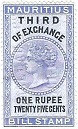
3. Negotiable instruments with special reference to Bills of Exchange
4. Locally printed Bills of Exchange imperforate stamps first used in 1869
5.
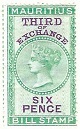
Stamps printed by Thomas De La Rue Ltd in Great
Britain from 1869 onwards to the earlier part of the twentieth century
and divided into:-
d. Inland Revenue and Postage stamps
From time to time, I have deviated from the purely
philatelic aspects to dwell briefy upon various social and commercial
activities of the island of Mauritius, in the hope that this will be of
assistance in helping the reader to understand and appreciate some of
the background to the stamp issues involved.
Over the years, I have inspected four different
published catalogues, which cover mainly the items under headings 5 and
6 above. the first o f these was Walter Morley's "Catalogue and Price
List of the Revenue Stamps of the British Colonies". The second and, I
believe, final edition was published in 1910. Then came "Catalogue
Fiscal", a French product
by A Forbin covering the whole world, the third, and last,
edition of which was printed in 1915. George R Wren produced the next
one in 1935. He was an American who specialised in Mauritius philately,
and his catalogue is confined to that country, and is entitled "The
Revenue Stamps of Mauritius". Finally came John Barefoot and his company
J Barefoot Ltd with the "British Commonwealth Revenues", which reached
its ninth edition (in full colour) in 2012.
Although all
of these publications can still be found, my references in this
book almost exclusively relate to Barefoot.
First, one must understand the nature of a revenue
Stamp, and what it is used for. Not everyone would agree with the
headings on the above list, but I can do no better than to quote a
definition from the Revenue Society which reads as follows:-
"....stamps, whether impressed, adhesive or
otherwise, issued by International, National or Local Governments, their
Licencees or Agents, and indicate that a tax, duty or fee has been paid
or prepaid or that
permission has been granted."
Wikipedia, the free online encyclopedia, states:-
Both definitions have their merits, but I think
that I prefer te first one. It is not, however, mentioned in either
definition that no document is enforceable at law if it does not have
the amount of tax or duty paid required by law.