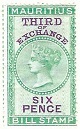
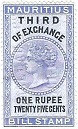
A Brief Introduction to the Island of Mauritius
I will not bore you with
many facts about the island - there will
be more than
enough of these later on to satisfy the statisticians amongst the
readers - but just a brief sketch. For those who want more data on
history, geography, commerce etc, this is available in other philatelic
books and there is plenty on the internet for anyone who wants to probe
further.
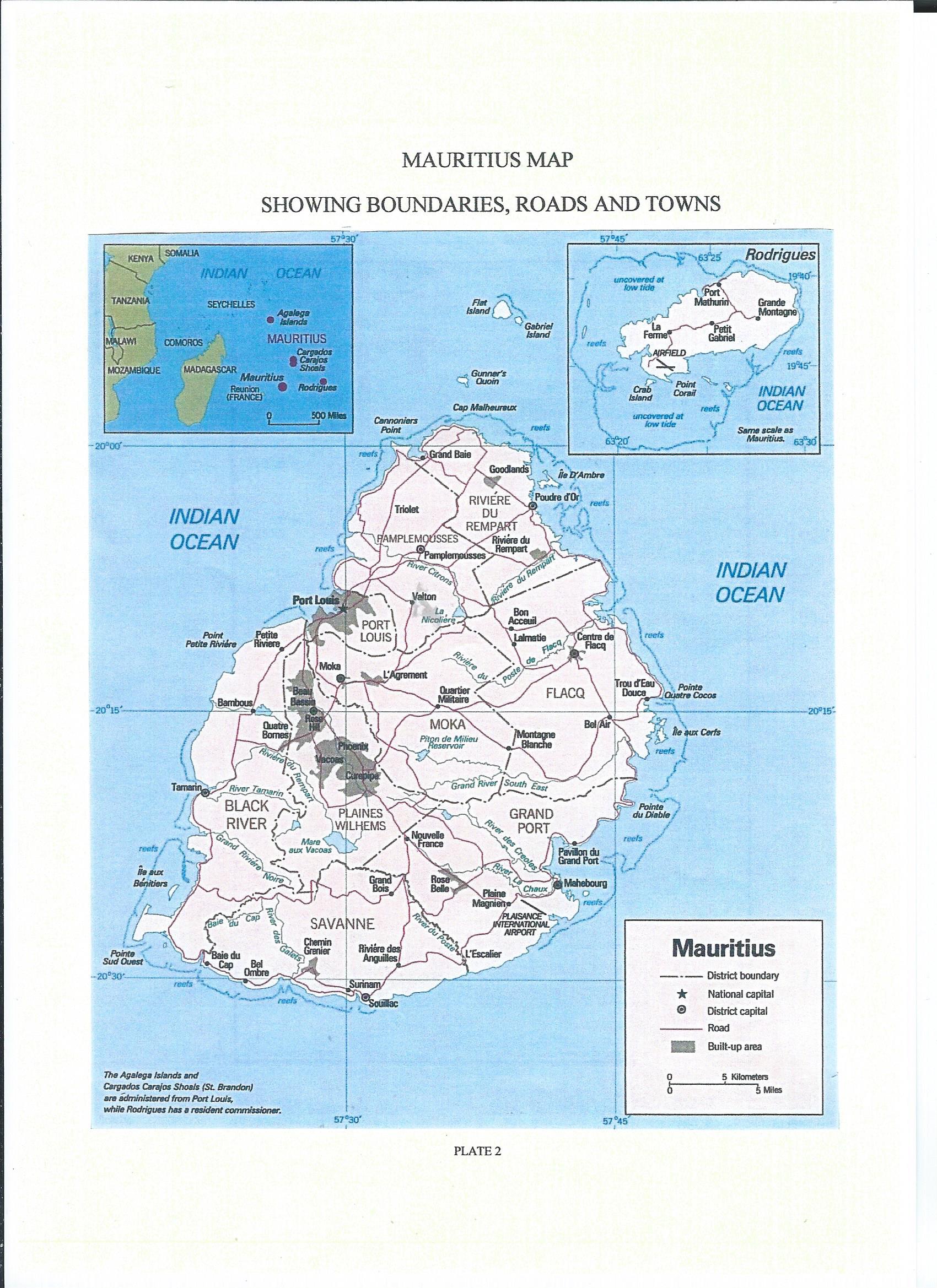
Mauritius is an island located about 200 miles east
of the island of Réunion, which itself rests in the Indian Ocean off the
east coast of Africa.
Plate 1 and
Plate 2 show its economic
activity and land use,
together with a map of the boundaries, roads and towns. It is surrounded
by a small number of islands, the most important of which is Rodrigues,
which lies about 500 or so miles to the north east, and has some limited
additional philatelic interest with its own local postal cancels on
Mauritian stamps , and comes under Mauritian administration.
Mauritius is volcanic in origin, and is quite
mountainous although no mountains reach a great height. The coast is
largely surrounded by coral reefs. It is small, covering in total
about 720 square miles, roughly the size of Surrey in England.
The capital is Port Louis, with its superb harbour,
and the total population of the island is about 1.2million. Because of
the terrain, it is deemed to be over-populated. The inhabitants are
largely of Indian extraction followed by Africans, Chinese, English and
French. The official language is English, although French follows
closely behind; many of the publications cover both languages. Examining
the names of the towns and villages, one could be forgiven for thinking
that it is a French colony. Indeed it was up to 1810, when the British
invaded and took over. Prior to the French, it was occupied by the
Portuguese and then the Dutch.
As far as commerce is concerned, Mauritius was well
known as a sugar producing island. Growing sugar cane was the principal
agricultural crop, and processing factories existed in many places,
coupled with an extensive rail system throughout the lowland areas,
largely used to carry the product to the harbours at Port Louis and
Mahebourg for export round the world. Gradually, sugar growing became
less commercially attractive, although many areas still exist, due to a
combination of reduction in demand and the increase in world
agricultural competition.
Many of the factories have fallen into disuse, although some have been
converted to museums and other tourist attractions. Despite this, sugar
remains by far the predominant agricultural crop, although it now only
accounts for about two percent of the gross domestic product.
Commercially, however, Mauritius has not stood
still or declined. The tourist trade has boosted local income
substantially with the advent of many high-class hotels all confined to
two-storey construction, and cheaper air travel. The latter has been
achieved without resort to charter flights: I believe that these still
do not exist to the island. A very high standard of
tourism has therefore been established. Alongside this, there is
a rapidly developing textile industry, which exports competitively
priced clothes to many parts of the world. Financially, the island has a
thriving banking, insurance and allied services complex, and offers tax
haven facilities.
The country is now a republic with one legislative
house. The Chief of State is the President and the Head of Government is
the Prime Minister. Mauritius is still a member of the Commonwealth and
was originally part of the British Empire until it gained
self-government in 1967.
Philatelic Prominence
Mauritius was the first Crown Colony to issue postage stamps. As many readers will be aware, the most famous stamps to come from the island were the locally-engraved 1d and 2d ‘Post Office’ imperforates of 1847. Only 500 of each denomination were issued of which, according to the British Library, only 27 now exist. Prices of around £1 million per stamp are now common on the very rare occasions they come to the market. Most are now held in permanent museums in various parts of the world
Much has been written about the ‘Post Office’ issues, from the history of their production, their use and their provenance from owner to owner via auction to auction. This has resulted in the stamps acquiring a romantic historical quality unsurpassed by any other issue in the world. Their reputation has rubbed off on the subsequent attractiveness of the country as a collecting medium of stamps of the island produced after these first gems.
Being a small country, Mauritius has a limited
variety of postage stamps, restricted in many ways by the absence of
much civilised history and also by the excellent issuing policy of the
authorities limited to only a few commemoratives each year coupled with
only the occasional change of definitives. Therefore, a keen collector
of this island’s philately is often directed towards alternative themes,
such as postal history, postal stationery, postmarks, instructional
handstamps and suchlike. Also, Mauritius offers a wealth of
opportunities on the aspect of fiscal or revenue stamps, which are
rapidly becoming not only popular but quite elusive.